Blog ·
Commercial Dishwasher & Glasswasher Water Filter Guide | XZH OEM
Why glassware spots: hardness vs TDS targets, softener vs DI vs RO compared, and OEM warewash cartridges 30-50% below branded. MOQ 500 pcs. Get a quote.
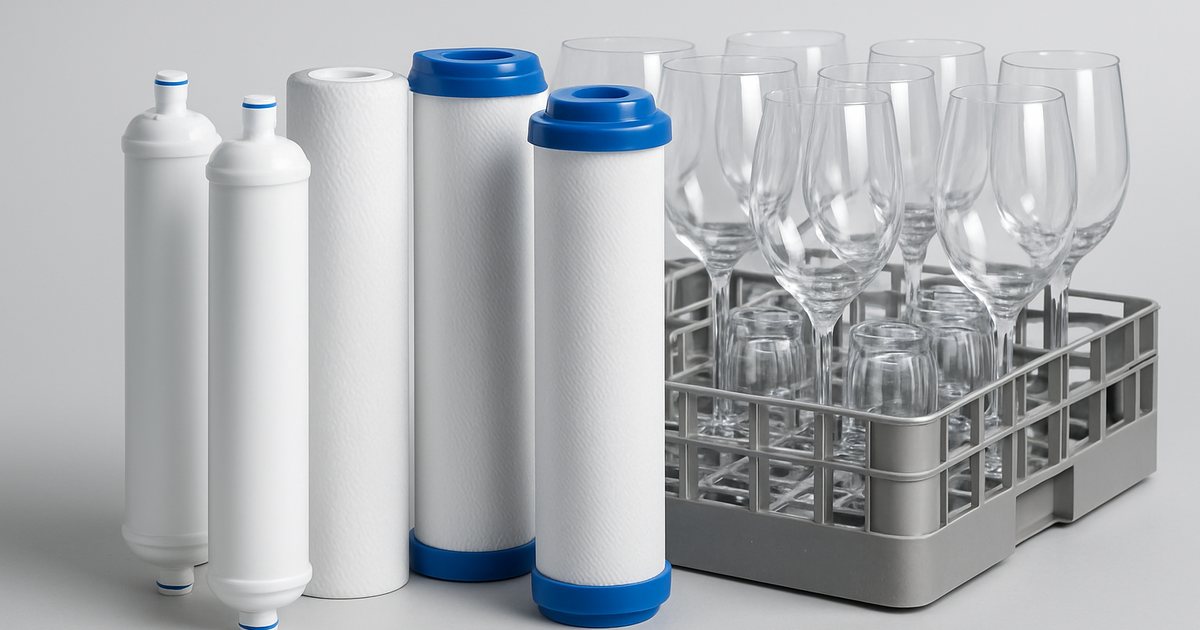
Quick answer: Spots on glassware are not a washing problem — they are a dissolved-solids problem, and they form after the wash cycle ends. Detergent, rinse aid, and hotter water cannot fix them. Bring final rinse conductivity below 50 µS/cm and spotting disappears; below 5 µS/cm and you can retire the hand-polishing cloth entirely. Hardness and TDS are separate targets: keep hardness under 3.5 grains per gallon (60 mg/L as CaCO₃) to protect the machine, and lower TDS separately to protect the glassware.
We manufacture warewash filter cartridges for foodservice distributors in 40+ countries, and the single most common specification error we see is an operator installing a water softener to solve spotting. It never works, and this guide explains exactly why — plus what to install instead.
Why Warewashing Is a Different Filtration Problem
Most commercial foodservice filtration guides treat all equipment the same: put a carbon block in front of it and move on. That advice works for coffee and ice, and it fails completely for warewashing, because the failure modes are different.
A coffee machine fails from scale — calcium carbonate precipitating on a hot boiler surface. An ice machine fails from scale plus sediment — cloudy cubes and fouled evaporator plates. A dishwasher has both of those problems and a third one that no other piece of foodservice equipment has: the water quality is visible to the customer.
Nobody inspects the inside of your espresso boiler. Every guest inspects the wine glass in front of them.
That visibility changes the specification. For coffee and ice, you filter to protect equipment. For warewashing, you filter to protect equipment and to hit a cosmetic water-purity target that is roughly an order of magnitude stricter than anything else in the kitchen.
| Application | Primary Failure Mode | Hardness Target | TDS / Conductivity Target |
|---|---|---|---|
| Espresso / coffee | Boiler scale | 50–100 mg/L (retain some) | 75–250 mg/L TDS — do not strip |
| Ice machine | Scale + cloudy ice | < 60 mg/L | < 150 mg/L TDS |
| Combi oven / steamer | Boiler scale, element failure | < 60 mg/L | < 100 mg/L TDS |
| Dishwasher (plates/pans) | Scale + filming | < 60 mg/L (3.5 gpg) | < 200 mg/L TDS |
| Glasswasher (stemware) | Visible spotting | < 60 mg/L (3.5 gpg) | < 30 µS/cm (~15 mg/L TDS) |
| Glass polishing standard | Zero visible residue | n/a | < 5 µS/cm |
The bottom two rows are where the money is. A restaurant group that stops hand-polishing 400 glasses a night recovers roughly 45–60 minutes of labour per site per shift — which in most markets pays for the entire water treatment system inside a year.
The Chemistry: Why Spots Form After the Wash
The mechanism is simple arithmetic, and understanding it tells you exactly which treatment to buy.
When a rack exits the final rinse, each glass carries a thin residual film of rinse water — typically 0.3 to 1.0 mL per glass depending on shape and rack drainage. That water evaporates. Everything dissolved in it does not.
At 300 mg/L TDS (common municipal water), 0.5 mL of residual film deposits 0.15 mg of solid mineral on the glass surface. Repeat that across a shift and it becomes the cloudy haze that no amount of rewashing removes, because rewashing adds another 0.15 mg.
Three consequences follow directly from this arithmetic:
- Rinse aid does not remove minerals. Rinse aid is a surfactant — it lowers surface tension so water sheets off instead of beading, reducing the volume of residual film. That helps, but a 50% reduction in film volume only halves the deposit. It cannot get you to zero.
- Hotter rinse water makes it slightly worse, not better. Calcium carbonate solubility decreases with temperature. A NSF/ANSI 3 compliant high-temp final rinse at 180 °F (82 °C) is at the point where CaCO₃ is least soluble.
- Softening does not help at all. Ion exchange replaces Ca²⁺ and Mg²⁺ with Na⁺. Total dissolved solids are unchanged — in fact they rise slightly, because you exchange one calcium ion for two sodium ions by charge balance. Softened water leaves sodium spots instead of calcium spots. They are less crusty and easier to wipe, which is why softeners feel like they help, but the glass is not spot-free.
Factory note: We test every warewash cartridge batch on 250 mg/L synthetic hard water and measure outlet conductivity, not just hardness. Hardness-only testing is how softener-based systems get sold into glasswashing applications where they were never going to work.
Looking for a reliable water filter manufacturer?
Get free samples and a factory-direct quote. MOQ from 500 pcs.
Get a Free Quote →Treatment Options Compared: Softener vs Partial DI vs Full DI vs RO
Here is the honest comparison, including the costs that equipment-brand articles leave out.
| Water Softener | Partial Demineralization (WAC) | Full DI (Mixed Bed) | Reverse Osmosis | RO + DI Polish | |
|---|---|---|---|---|---|
| Removes hardness | Yes (100%) | Yes (~90%) | Yes (100%) | Yes (95–98%) | Yes (>99%) |
| Lowers TDS | No | Partial (~50%) | Yes (>99%) | Yes (95–98%) | Yes (>99.5%) |
| Spot-free glassware | ❌ No | ⚠️ Improved | ✅ Yes | ✅ Yes | ✅ Yes (polish-free) |
| Protects machine from scale | ✅ Yes | ✅ Yes | ✅ Yes | ✅ Yes | ✅ Yes |
| Wastewater | Regeneration brine | None | None | 25–50% reject | 25–50% reject |
| Consumable | Salt (~$8/bag) | Cartridge / resin | Cartridge / resin | Membrane 18–24 mo | Membrane + small DI |
| Running cost, hard water | Low | Medium | Very high | Low | Lowest at quality |
| Typical install cost | $$ | $$ | $ | $$$ | $$$ |
The DI capacity trap. This is the specification error that costs operators the most money, and it deserves numbers rather than adjectives.
Mixed-bed ion exchange resin delivers roughly 100–150 gallons of deionized water per cubic foot of resin at 200 ppm feed TDS. A standard 2.5 × 10 inch cartridge holds about 0.05 ft³ of resin — which works out to approximately 33 gallons at 200 ppm feed. Capacity scales inversely with TDS:
| Feed Water TDS | 2.5×10” DI Cartridge Yield | 2.5×20” DI Cartridge Yield | Days of Service (1 glasswasher, 20 gal/day) |
|---|---|---|---|
| 50 ppm | ~130 gal | ~260 gal | 6.5 days / 13 days |
| 100 ppm | ~66 gal | ~132 gal | 3.3 days / 6.6 days |
| 200 ppm | ~33 gal | ~66 gal | 1.6 days / 3.3 days |
| 400 ppm | ~17 gal | ~34 gal | < 1 day / 1.7 days |
A single glasswasher consumes 15–25 gallons of rinse water per day. On 200 ppm municipal water, a DI-only installation burns a cartridge every day and a half. Operators discover this after the first month’s consumable invoice, and the system gets abandoned.
Put a small RO membrane in front and feed TDS drops from 200 ppm to roughly 6 ppm. The same DI cartridge now runs for 20–30 times longer — months, not days — because it is polishing, not doing the bulk work. This is why RO + DI polish is the specification we build cartridge sets for, and why RO-only is the right answer for the large majority of operations that need spot-free but not polish-free results.
Sizing the System: Flow Rate and Storage
The second most common design error is sizing an RO system to average consumption rather than peak demand.
A glasswasher final rinse draws water in short, high-flow bursts — typically 0.8–1.5 GPM for 10–20 seconds per cycle. An RO membrane produces water slowly and continuously; a 300 GPD membrane makes about 0.2 GPM. Connect them directly and the rinse starves, the cycle runs short, and you get worse results than unfiltered water.
The correct architecture is RO into an atmospheric or pressurized storage tank, then a delivery pump to the machine:
| Warewasher Type | Rinse Water per Cycle | Cycles/Hour (peak) | Peak Demand | Recommended RO + Storage |
|---|---|---|---|---|
| Undercounter glasswasher | 0.5–0.8 gal | 30 | ~24 gal/h | 200 GPD + 10 gal tank |
| Undercounter dishwasher | 0.7–1.0 gal | 30 | ~30 gal/h | 300 GPD + 14 gal tank |
| Door-type (hood) machine | 1.0–1.2 gal | 60 | ~70 gal/h | 600 GPD + 30 gal tank |
| Conveyor / rack machine | 0.6–0.9 gal/rack | 150+ | ~120 gal/h | 1,200 GPD + 60 gal tank |
Size the tank to cover the peak two-hour service window, not the whole day — the membrane refills the tank during slow periods. For a bar that does 80% of its glass volume between 21:00 and 23:00, that two-hour figure is what matters.
Need help matching cartridges to a specific machine model? Send us the equipment list and your water report — we size these systems for distributors every week.
The Pre-Treatment Stage Everyone Skips
An RO membrane is destroyed by free chlorine. Thin-film composite (TFC) polyamide membranes — the type in essentially every commercial RO system — tolerate a cumulative exposure of roughly 1,000 ppm-hours of free chlorine before measurable rejection loss. At a typical municipal residual of 1.0 mg/L, that is about 1,000 hours of operation, or six weeks of continuous service.
A carbon block ahead of the membrane is not optional. Neither is knowing which kind you need:
- Free chlorine — a standard coconut-shell carbon block removes it efficiently. Contact time of 5–10 seconds is sufficient. Our standard CTO carbon block cartridges are specified for this duty.
- Chloramine — increasingly common in municipal supplies and much harder to remove. Standard carbon reduces chloramine poorly; you need catalytic activated carbon and roughly double the contact time. If your water utility has switched to chloramine and the RO membranes started failing early, this is why. See our chloramine removal guide for the media specification.
Ahead of the carbon, a 5 micron sediment pre-filter protects the carbon block from premature blinding. In municipal supply this cartridge is cheap insurance; on well water or in cities with aging cast-iron mains it is the difference between a carbon block lasting six months and lasting six weeks.
The full warewash train, in order:
- 5 µm PP sediment — particulate, rust, pipe scale
- Coconut-shell carbon block (or catalytic carbon if chloramine) — protects the membrane
- RO membrane — removes 95–98% of TDS
- Storage tank + delivery pump — decouples slow production from fast demand
- (Optional) Mixed-bed DI polish — final few ppm, only if you need polish-free stemware
Cost Analysis: What Operators Actually Spend
Numbers for a mid-size restaurant with one undercounter glasswasher and one door-type dishwasher, on 250 mg/L municipal water, over three years.
| Line Item | No Treatment | Softener Only | RO System |
|---|---|---|---|
| Equipment / install | $0 | $1,200 | $2,400 |
| Consumables (3 yr) | $0 | $290 salt | $520 cartridges + membrane |
| Deliming service calls | $1,800 (6 × $300) | $300 (1 × $300) | $0 |
| Booster element replacement | $650 | $0 | $0 |
| Glass breakage (hand polishing) | $900 | $700 | $0 |
| Hand-polishing labour | $9,400 | $7,000 | $0 |
| 3-year total | $12,750 | $9,490 | $2,920 |
Labour is the dominant term and it is the one most operators leave out of the comparison. At 45 minutes per shift, 6 shifts a week, at a modest USD 12/hour fully loaded, hand-polishing costs about $1,050 per year per site — more than the entire RO system in year one.
For distributors, this table is your sales argument. The filtration hardware is not the product; the eliminated labour line is.
Sourcing OEM Warewash Cartridges
Warewash filtration is a consumables business. The system sells once; the cartridges sell forever. That is why the margin structure matters more here than in almost any other foodservice category.
Branded warewash cartridges from equipment OEMs typically retail at USD 45–120 depending on capacity and media type. The physical product — a polypropylene housing, coconut-shell carbon, mixed-bed resin, food-grade gaskets — is manufactured to the same dimensional standards by a relatively small number of factories worldwide.
What we manufacture for warewash applications:
| Format | Common Duty | Our MOQ | Lead Time |
|---|---|---|---|
| 10” standard (2.5”×10”) PP / CTO / GAC | Sediment + carbon pre-treatment | 500 pcs | 20–25 days |
| 20” standard (2.5”×20”) | High-flow pre-treatment | 500 pcs | 20–25 days |
| 10” mixed-bed DI | Final polish after RO | 500 pcs | 25–30 days |
| Quick-connect inline (John Guest 1/4”–3/8”) | Compact undercounter installs | 500 pcs | 20–25 days |
| Everpure-compatible bayonet | Retrofit into existing heads | 500 pcs | 25–30 days |
| RO membrane elements (75–1,200 GPD) | Bulk TDS removal | 200 pcs | 25–30 days |
Private labelling — printed sleeve, custom end-cap colour, your part number and capacity rating — is available at the same MOQ with no tooling charge for standard formats. Custom end-cap geometry requires tooling and a 3,000 piece first order.
What to verify before placing an order with any supplier:
- NSF/ANSI 42 certification on the carbon media, with the certificate number traceable to the listing. Ask for the certificate, not a claim.
- Coconut-shell carbon, not coal-based. Coconut shell has a higher microporous surface area (typically 1,100–1,200 m²/g vs 900–1,000 m²/g) and lower ash content. It matters for chlorine capacity and for taste on any shared drinking-water branch. See our carbon media comparison.
- Documented chlorine reduction test data at rated flow and rated capacity, not just at initial breakthrough.
- Mixed-bed resin grade for DI cartridges — nuclear-grade or semiconductor-grade resin costs more and lasts longer than industrial grade. Ask which one is in the quote.
- ISO 9001 certification and a factory audit report or video walkthrough.
For a fuller checklist covering payment terms, sample protocol and inspection, see our importer’s guide to sourcing OEM water filters from China.
Troubleshooting Guide: Reading the Symptoms
The visible defect tells you which stage of the system failed.
| Symptom | Likely Cause | Fix |
|---|---|---|
| White chalky spots, wipe off with effort | High calcium hardness in rinse | Add RO or DI; softener alone insufficient |
| Faint uniform haze, will not wipe off | Silica in feed water (etching) | RO required; DI alone does not remove silica reliably |
| Spots appeared suddenly after months of clean results | RO membrane failing or DI resin exhausted | Test outlet TDS; replace membrane or cartridge |
| Streaks rather than spots | Rinse aid dosing too high or too low | Adjust dispenser before touching filtration |
| Cloudy film on plastics only | Detergent redeposition, not water | Wash chemistry issue, not filtration |
| Rinse cycle runs short / low pressure | Undersized storage or clogged pre-filter | Check pre-filter Δp; upsize tank |
| Scale on booster element despite filter | Filter is carbon-only, no hardness treatment | Carbon does not remove hardness — add RO/softener |
The third row deserves emphasis: install a TDS meter on the treated line. A $25 inline TDS monitor turns every one of these diagnoses from guesswork into a five-second reading, and it tells you when the membrane is dying weeks before the glassware does.
Key Takeaways
- Spotting is a dissolved solids problem, not a cleaning problem. It forms after the wash cycle and no wash chemistry fixes it.
- A softener will not stop spotting. It exchanges calcium for sodium and leaves TDS unchanged. It protects the machine, nothing more.
- Target < 3.5 gpg hardness for equipment protection and < 30 µS/cm rinse conductivity for spot-free glassware. These are two separate targets requiring two different treatments.
- DI alone is a trap on hard water — roughly 33 gallons per 10-inch cartridge at 200 ppm. Always put RO in front of DI.
- Size RO to peak two-hour demand with storage, never to average daily consumption.
- The business case is labour, not hardware: eliminated hand-polishing pays for the system inside a year.
Sourcing warewash filtration cartridges for your foodservice customers? XZH manufactures the full pre-treatment and polishing range — PP sediment, coconut-shell carbon block, catalytic carbon, mixed-bed DI, quick-connect inline, and RO membrane elements — with NSF 42 certified media and ISO 9001 production. MOQ from 500 pieces, private label available at no tooling charge.
Request OEM pricing and specifications → or explore our commercial filtration range.
Related Guides
- Commercial Water Filtration Solutions — Full foodservice catalog: warewashing, ice, coffee, and beverage applications.
- Restaurant Water Filtration: The Complete Guide — Whole-kitchen system design across all equipment types.
- DI Mixed-Bed Ion Exchange Cartridge Guide — Resin grades, capacity calculations, and colour-indicating options.
- Scale Inhibitor vs Softener vs RO — Which scale control technology fits which application.
- Combi Oven & Steamer Water Treatment — The other high-temperature appliance with strict water requirements.
- PP Sediment Filter Cartridge Guide — Micron ratings and specification for pre-treatment stages.
- Quick-Connect Inline Cartridges — Compact formats for undercounter and tight-space installations.
- Tankless RO Systems — Higher-recovery RO platforms for commercial kitchens.
Frequently Asked Questions
- Why do glasses come out of a commercial glasswasher with spots even though the machine is clean?
- Spots are not a cleaning failure — they are a water chemistry failure. The final rinse water leaves a thin film on the glass surface. When that film evaporates, everything dissolved in it stays behind as a visible deposit. If your rinse water measures 300 mg/L TDS, every millilitre left on a glass deposits 0.3 mg of solid mineral. Detergent, rinse aid and wash temperature have no effect on this, because the deposit forms after the wash cycle ends. The only fix is to lower the dissolved solids in the final rinse water. Aim for under 50 µS/cm conductivity for visually spot-free glassware, and under 5 µS/cm if you need genuinely polish-free results on stemware.
- What water hardness is acceptable for a commercial dishwasher?
- Equipment manufacturers converge on 3.5 grains per gallon (60 mg/L as CaCO3, roughly 3.4 °dH or 6 °fH) as the upper limit for trouble-free warewasher operation. Above 7 gpg (120 mg/L) you should expect visible scale on the booster heater element within 6-12 months and a deliming service call every quarter. Note that hardness and TDS are different measurements: you can meet the 3.5 gpg hardness target with a softener and still get heavy spotting, because a softener exchanges calcium for sodium without lowering total dissolved solids at all.
- Should I use a water softener, DI cartridge, or RO system for a glasswasher?
- It depends on which problem you are solving. A softener protects the machine from scale but does nothing for spotting — it swaps calcium for sodium and TDS stays the same. A DI (deionization) cartridge removes essentially all dissolved ions and gives spot-free results, but its capacity collapses on hard feed water: a 2.5x10 inch mixed-bed cartridge yields only around 33 gallons on 200 ppm feed. RO is the practical answer for most operations — it removes 95-98% of dissolved solids continuously, and if you need the final few ppm removed, a small DI polishing cartridge downstream of RO lasts 20-30 times longer than DI alone.
- How long does a DI cartridge last on a glasswasher?
- Capacity scales inversely with feed TDS. Mixed-bed resin delivers roughly 100-150 gallons per cubic foot of resin at 200 ppm feed water, so a standard 2.5x10 inch cartridge (about 0.05 cubic feet of resin) produces roughly 33 gallons at 200 ppm, around 66 gallons at 100 ppm, and under 20 gallons at 400 ppm. A single glasswasher using 15-25 gallons of rinse water per day would exhaust one cartridge every day or two on typical municipal water. This is why DI-only setups are almost always a mistake in foodservice — put an RO stage in front and the same cartridge runs for months.
- Does a commercial dishwasher water filter need NSF certification?
- For warewashing specifically, no health-contact certification is legally required in most jurisdictions because the water is not consumed — the applicable standard is NSF/ANSI 3 for the warewashing machine itself, not the filter. However, foodservice operators frequently plumb one filter manifold for both the dishwasher and the ice machine or beverage line. If any branch feeds drinking water, that branch must use NSF/ANSI 42 certified media at minimum. We recommend specifying NSF 42 certified carbon media across the entire manifold — the cost difference is negligible and it removes the compliance question entirely during a health inspection.
- What does an OEM warewash filter cartridge cost compared with branded replacements?
- Branded warewash cartridges from equipment OEMs typically retail at USD 45-120 per cartridge depending on capacity and media. Equivalent OEM-manufactured cartridges from an ISO 9001 factory, built to the same dimensional standard with the same coconut-shell carbon and mixed-bed resin, land at 30-50% below that. For a 20-location restaurant group replacing two cartridges per site per year, the difference is USD 1,000-2,500 annually. Our MOQ starts at 500 pieces for standard 10-inch and quick-connect formats, with private labelling and custom capacity ratings available at the same MOQ.
- Can the same filter serve the dishwasher, ice machine, and coffee machine?
- Partly. A shared sediment and carbon pre-filter stage is efficient and we recommend it — it protects everything downstream and consolidates cartridge inventory. But the final treatment must diverge, because the three applications want different water. Coffee wants 50-100 mg/L residual hardness for extraction quality, so it must never see RO or DI water without remineralization. Ice machines want low TDS to avoid cloudy cubes but tolerate moderate hardness with a scale inhibitor. Glasswashers want the lowest TDS you can economically produce. Size a common pre-filter manifold, then branch to application-specific final stages.
Looking for OEM Water Filter Cartridges?
Get a factory-direct quote from Ningbo XZH — 15+ years OEM experience, 50+ export markets, MOQ from 500 pcs.
Get a Free Quote →Get Our Full Product Catalog
100+ SKUs with specs, MOQ, and factory-direct wholesale pricing — everything covered in this article and more.