Blog ·
Is Your Water Filter EU-Compliant After 31 December 2026?
From 31 Dec 2026, EU rules split a filter cartridge in two: caps, wraps and seals need an EU certificate, carbon and resin stay national. A factory checklist.
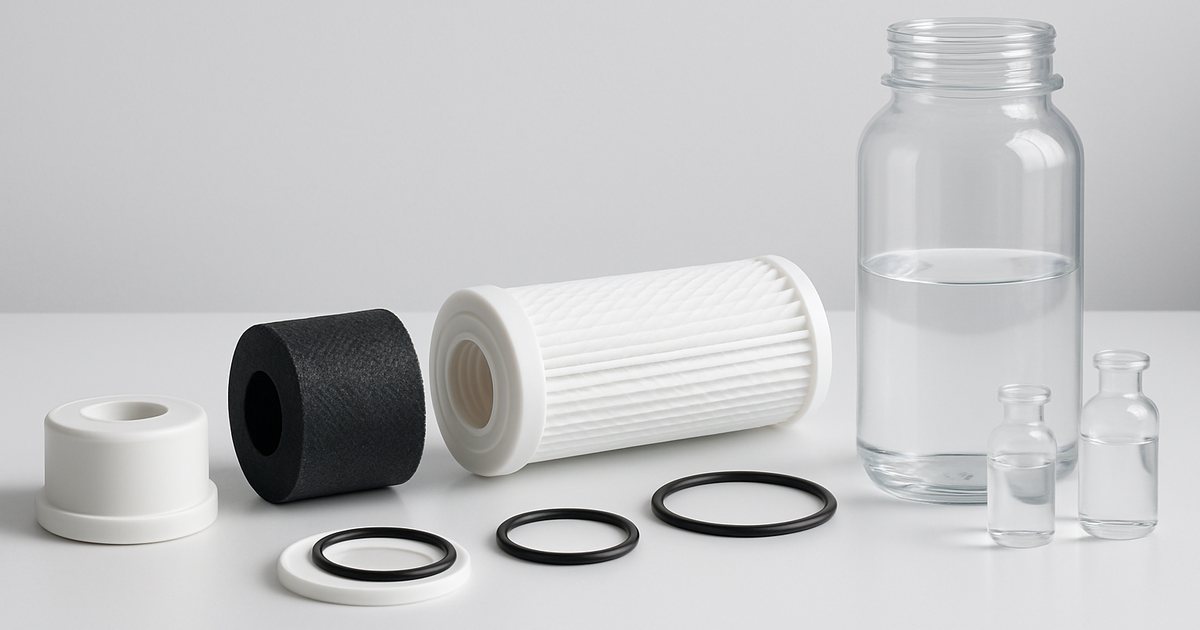
Short answer: From 31 December 2026, the EU stops treating a water filter cartridge as one product. The plastic, rubber and metal parts that touch drinking water (housing, end caps, outer wrap, centre core, O-rings) fall under Article 11 of the Drinking Water Directive (EU) 2020/2184. They must be made only from substances on the new European positive lists, pass migration testing, be certified by a notified body (certificate valid 5 years) and carry the new EU drinking water symbol. The filter media (carbon, ion exchange resin, KDF) falls under Article 12 and stays under national rules. Products with a valid national certificate (KTW-BWGL, ACS, KIWA) on 31 December 2026 can stay on that national market until 31 December 2032. A new product launched in 2027 gets no transition period.
We manufacture PP, CTO carbon block, UF and quick-connect cartridges in Ningbo, and EU distributors are now asking us what this means for orders they will place in 2027. This guide is our answer, read from the primary legal texts rather than from summaries. We also say plainly where the texts leave the answer open.
Last updated: 2026-10-13
Key takeaways
- Six EU acts published on 23 April 2024 all apply from 31 December 2026. The national approval schemes (KTW-BWGL, ACS, KIWA) stop being the entry ticket for new products.
- A cartridge is split: caps, wrap, core, seals and housing → Article 11 (EU certificate); carbon, resin, KDF → Article 12 (national rules, EN standards such as EN 12915-1).
- Risk group 1–2 products need Module B + D: a notified-body audit of the factory before certification and every year after that. Risk group 3–4 products need Module B + C.
- National certificates valid on 31 December 2026 carry a product until 31 December 2032, but only in the Member State that recognises them.
- Each positive-list entry has an expiry date. Bisphenol A (CAS 80-05-7) is listed at 2.5 µg/l at the tap and expires on 31 December 2028.
What Actually Changes on 31 December 2026
Article 11 has been in the Directive since it was adopted in December 2020. What was missing until April 2024 were the rules that make it work. Six Commission acts were published on 23 April 2024, and every one of them states the same application date.
| Act | What it does | Applies from |
|---|---|---|
| Implementing Decision (EU) 2024/365 | How starting substances are tested and accepted for the positive lists | 31 Dec 2026 |
| Implementing Decision (EU) 2024/367 | The European positive lists (organic, cementitious, metallic, enamel/ceramic) | 31 Dec 2026 |
| Implementing Decision (EU) 2024/368 | How final materials are tested: migration, odour, taste, TOC, microbial growth, risk groups | 31 Dec 2026 |
| Delegated Regulation (EU) 2024/369 | Procedure for adding or removing substances (applications go to ECHA) | 31 Dec 2026 |
| Delegated Regulation (EU) 2024/370 | Conformity assessment (Modules B+C or B+D) and notified bodies | 31 Dec 2026 (2032 for valid national certificates) |
| Delegated Regulation (EU) 2024/371 | The harmonised marking (symbol + “Suitable for drinking water”) | 31 Dec 2026 |
The European Commission sums up the aim as “one standard – one test – one market”. Today a cartridge sold in Germany, France and the Netherlands may need three national approvals. From 2027, a new product needs one EU certificate.
Article 11(7) also makes the rule enforceable at the border: Member States must ensure that only products using final materials approved under the Directive “can be placed on the market”, and the EU market surveillance regulation, (EU) 2019/1020, applies. In practice that means customs and market surveillance authorities, not just the water utility, can stop a shipment.


Article 11 vs Article 12: Where the Line Runs Through a Cartridge
This is the part most summaries skip, and it decides which tests you pay for.
Article 11 covers materials used in installations for “the abstraction, treatment, storage or distribution” of drinking water. Article 12 is a separate article for “treatment chemicals and filter media”. It asks Member States to assess their purity “by using relevant European standards”. The Commission’s implementation page says it directly: filter media “cannot be conformity-assessed at EU level under Article 11”, and Article 12 is lex specialis.
So the media is handled nationally, while everything that holds the media in place is handled at EU level. Here is how that splits a typical 10-inch carbon block cartridge in a standard housing:
| Part | Typical material | Regime | What your notified body will ask for |
|---|---|---|---|
| Housing sump and head | PP, ABS or SAN | Article 11 | Resin grade, masterbatch, positive-list check, migration test |
| End caps | PP or ABS | Article 11 | Resin grade + colour masterbatch formulation |
| End-cap adhesive (hot melt) | Polyolefin or EVA hot melt | Article 11 | Full starting-substance list. This is often proprietary to the sub-supplier. |
| Outer wrap / prefilter sleeve | PP non-woven | Article 11 | Resin + spin finish / surfactant on the fibres |
| Centre core / netting | PP or HDPE | Article 11 | Resin grade |
| O-rings and gaskets | EPDM or silicone | Article 11 | Compound formulation (curing system, fillers) |
| Carbon block | Coconut-shell carbon + binder | Article 12 | National requirements; EN 12915-1 for granular activated carbon |
| Ion exchange resin, KDF | Resin beads, Cu-Zn granules | Article 12 | National requirements; EN 12873-3 is the migration test method for resins |
| Silver-impregnated carbon | Carbon + Ag | Article 12 + Biocidal Products Regulation (EU) 528/2012 | Article 12(3) applies “without prejudice to” the BPR. A bacteriostatic claim brings in biocide rules. |
Planning a 2027 EU range?
Send us the model list. We will return a part-by-part material sheet (resin grade, sub-supplier, Article 11 or 12) that you can hand to your notified body before you pay for any testing.
Request a material sheetFrom the factory side, the gaps we expect are not in the polypropylene. Propylene (CAS 115-07-1) is on the organic positive list, with an expiry date of 31 December 2034. The gaps are in the small proprietary inputs: hot-melt adhesive, colour masterbatch, spin finish on non-woven fibres, and rubber curing packages. Their makers often won’t disclose full formulations to a cartridge factory, let alone to an importer. If any one of them is missing, the notified body cannot clear the final material.
Looking for a reliable water filter manufacturer?
Get free samples and a factory-direct quote. MOQ from 500 pcs.
Get a Free Quote →Which Filter Products Are in Scope?
The Directive defines the “domestic distribution system” as “the pipework, fittings and appliances which are installed between the taps that are normally used for water intended for human consumption … and the distribution network”. That definition is the best guide to where Article 11 stops. The industry implementation guide published by the European Drinking Water (EDW) alliance in March 2026 adds a warning: depending on national standards and legislation, “some devices may not be considered to be part of the domestic drinking water distribution system.”
Our working classification is below. Treat the right-hand column as a starting point to agree with your notified body, not as legal advice.
| Product | Where it sits | Our reading | Confidence |
|---|---|---|---|
| Whole-house cartridge and housing (point of entry) | In the building installation | Article 11 (housing, caps, seals) + Article 12 (media) | High |
| Under-sink cartridge feeding a drinking tap | Upstream of the tap | Article 11 + Article 12 | High |
| Inline quick-connect on an ice machine or coffee machine supply line | Plumbed into the installation, upstream of an appliance | Probably Article 11 | Medium |
| Cartridge inside a refrigerator | Inside a food appliance | Grey zone: Food Contact Materials Regulation (EC) 1935/2004 is the clearer rule | Low |
| Cartridge inside a coffee machine water tank | Inside a food appliance | Food contact rules (EC) 1935/2004 and (EU) 10/2011 | Medium |
| Pitcher or faucet-mount cartridge | After the tap | Outside Article 11; food contact rules apply | Medium |

If you sell quick-connect cartridges for under-sink systems or Everpure-compatible commercial cartridges into foodservice, the “Medium” row is the one to settle first. A cartridge on the cold-water line to an ice machine is plumbing. The same cartridge model sold for a countertop dispenser may not be.
Risk Groups: Why Your Cartridge Probably Needs a Factory Audit
Implementing Decision 2024/368 sorts non-metallic products into four risk groups by how much water they touch relative to the water they hold. Delegated Regulation 2024/370 then decides the procedure:
| Risk group | Examples (building installations) | Conformity procedure | What it means for a China-made cartridge |
|---|---|---|---|
| RG1 | Pipes and hoses (ID < 80 mm) | Module B + Module D | Notified body type-tests, audits the factory before certification and every year, runs annual reduced testing |
| RG2 | Fittings and ancillaries: valves, taps, storage tanks | Module B + Module D | Same as RG1. A full re-test every 5th year, reduced testing in between |
| RG3 | Components of RG2 products with < 10% of wetted surface | Module B + Module C | Notified body type-tests samples you supply; no mandatory annual audit |
| RG4 | Small components with < 1% of wetted surface (e.g. O-rings) | Module B + Module C | As RG3 |
The 10% and 1% thresholds come from the footnote to Table 5 of Annex I to 2024/368, as explained in the EDW guide. An assembled product is assessed at the risk group of its highest-risk component, and parts made of the same material are added together.
Here is what that means for a real cartridge. We estimated the wetted surface of a standard 10-inch CTO cartridge in a 10-inch housing, counting only the Article 11 parts. This is an illustrative calculation with our own dimensions, not a notified-body result:
| Part | Wetted surface (approx.) | Share | Likely group |
|---|---|---|---|
| Housing sump interior (≈ 115 mm ID × 280 mm) | ≈ 1,115 cm² | ≈ 61% | RG2 |
| PP non-woven outer wrap (63 mm OD × 250 mm) | ≈ 495 cm² | ≈ 27% | RG2 (over 10%) |
| Housing head | ≈ 150 cm² | ≈ 8% | RG3 if a different material from the sump |
| End caps (both faces) | ≈ 65 cm² | ≈ 3.6% | RG3 |
| O-rings | ≈ 3 cm² | ≈ 0.2% | RG4 |
The part everyone forgets is the outer wrap. It is a thin non-woven sleeve, but it holds about a quarter of the wetted surface. That alone puts it above the 10% line and into the audited Module B + D route. Our expectation is that most cartridge-plus-housing products for buildings will be certified as RG2. That means a notified-body auditor visits the production site in China every year, and the quality system there “must address specifically the requirements” of 2024/368.

The 2026–2032 Transition: Who Gets Six More Years
The transition clause sits in Article 11 of Delegated Regulation 2024/370. For products “assessed to be in conformity with national hygiene requirements” and “for which the national conformity certificate is still valid on 31 December 2026, it shall apply from 31 December 2032.”
| Your situation on 31 Dec 2026 | What happens |
|---|---|
| Valid KTW-BWGL / ACS / KIWA certificate | Keep selling in that Member State until 31 Dec 2032. Changes that affect hygienic properties can trigger reassessment. |
| National certificate expired before 31 Dec 2026 | No transition period. EU certificate needed. |
| No national certificate (most private-label cartridges from China) | No transition period. EU certificate needed before the product is placed on the market. |
| New model launched in 2027 | No transition period (Commission guidance). Notified body → EU certificate → Declaration of Conformity → marking. |
| Selling into Great Britain | Not affected. GB stays on the Water Supply (Water Fittings) Regulations 1999 and WRAS. |
There is also a practical squeeze. By 31 December 2026, each Member State must designate a notifying authority and a market surveillance authority, and make sure certification bodies can be accredited to ISO/IEC 17065. Until notified bodies are actually notified, nobody can issue an EU certificate. Ask any test house you are talking to for its notification number, not just its accreditation.
Positive Lists Have Expiry Dates
Article 11(4) says the positive lists “shall contain expiry dates”. Every entry in Implementing Decision 2024/367 has one. Two examples that matter for filters:
- Propylene (CAS 115-07-1, the monomer behind every PP cartridge): listed, expires 31 December 2034.
- Bisphenol A (CAS 80-05-7, used in polycarbonate and epoxy): maximum tolerable concentration at the tap 2.5 µg/l, use as an additive accepted only for plastics, expires 31 December 2028.
If your housing, quick-connect head or a clear sump is polycarbonate, or a part is epoxy-coated, a certificate issued in 2027 runs for five years, past the BPA expiry date. The Commission’s working view is that a product certificate’s 5-year validity “will generally be maintained” if a substance later comes off the list. Even so, we would not design a new EU range around a substance with a 2028 expiry. For new EU tooling, we recommend PP or ABS housings and heads, with no epoxy in the water path.

Marking: The Symbol and the Text
Delegated Regulation 2024/371 sets the marking. It is not a CE mark. A passive filter cartridge isn’t covered by any CE directive, so if a supplier prints “CE” on one, that tells you nothing about drinking water.
| Element | Requirement |
|---|---|
| Symbol | At least 5 mm high, indelible, on the product, its packaging and its documentation |
| If the part is too small, or sold as a spare | Symbol on packaging and documentation only |
| Text | ”SUITABLE FOR DRINKING WATER”, below the symbol, upper case, Helvetica Bold, ≥ 5 mm |
| Language | Documentation in the official language(s) of the Member State; packaging in at least one official language (e.g. “FÜR TRINKWASSER GEEIGNET”, “CONVIENT POUR L’EAU POTABLE”, “GESCHIKT VOOR DRINKWATER”) |
| Who affixes it | The manufacturer (inside or outside the EU) or its authorised representative in the EU |
For private-label buyers this is a packaging change. It also locks the artwork to the certificate. You cannot add the symbol to a box until the notified body has issued the certificate and you have signed the Declaration of Conformity.
A Document Checklist to Send Your Supplier Now
Whether you buy from us or anyone else, these are the documents to request in Q4 2026, before you commit to EU testing:
- Bill of materials for every wetted part: material, resin grade, sub-supplier name.
- Formulation disclosure or sub-supplier declaration for the masterbatch, hot-melt adhesive, non-woven spin finish and rubber compound. If a sub-supplier refuses, you need to know now.
- Current food-contact declarations for the plastics (Regulation (EU) No 10/2011 declarations of compliance). This isn’t the same as Article 11 approval, but it’s the fastest early screen.
- Media evidence for Article 12: carbon test reports to the relevant EN standard, and resin migration data.
- Change control: a written commitment that no wetted-part material or sub-supplier changes without notice. Under 2024/370, modifications must be reported to the notified body.
- Audit access: confirmation that the factory will host the notified body’s initial and annual inspections (RG1/RG2).

The cost lever most buyers miss is to reduce material variety before testing. Tests and certificates follow materials, not SKUs. Ten cartridge models sharing one end-cap resin, one masterbatch, one adhesive and one EPDM compound can be grouped as a product type series. Ten models from three sub-suppliers cannot.
For the wider sourcing picture, see our guides on water filter certifications (NSF, FDA, CE), the Netherlands water filter market, legal compatible vs counterfeit cartridges and starting a private-label water filter brand.
Where We Stand, Honestly
We do not currently hold KTW-BWGL, ACS, KIWA or WRAS approvals. So none of our cartridges can use the 2032 transition, and any EU programme with us starts on the new EU route. That cuts both ways. You don’t inherit a national certificate. You also don’t have a product range built on materials chosen before the positive lists existed.
What we offer EU distributors for 2027:
- A frozen bill of materials per SKU family, using PP/ABS wetted parts, with resin grades and sub-suppliers named for your notified body.
- Production-site access for initial and annual notified-body inspections.
- Article 12 media from carbon suppliers with active NSF certification (see our coconut shell activated carbon guide and CTO carbon block guide).
- OEM and private label from around 2,000 pieces per SKU, through our OEM manufacturing service, with packaging artwork that leaves room for the EU symbol and the official-language text.
Related Guides
- PP sediment filter cartridges: specifications and OEM sourcing
- Water filter cartridge quality inspection (AQL and tests)
- How to source water filter cartridges from China
- Full product catalogue
Sources: Directive (EU) 2020/2184, Articles 2(2), 11 and 12 (OJ L 435, 23.12.2020); Commission Implementing Decisions (EU) 2024/365, 2024/367, 2024/368 and Delegated Regulations (EU) 2024/369, 2024/370, 2024/371 (OJ L, 23.4.2024); European Commission, “Implementation of the Drinking Water Directive” (Green Forum, accessed 13 October 2026); European Drinking Water (EDW), Industry Implementation Guide v1.0, March 2026. This article is technical guidance from a manufacturer and is not legal advice.
Frequently Asked Questions
- What changes for water filter cartridges in the EU on 31 December 2026?
- On 31 December 2026 the implementing and delegated acts under Article 11 of the Drinking Water Directive (EU) 2020/2184 start to apply: Implementing Decisions (EU) 2024/365, 2024/367 and 2024/368 and Delegated Regulations (EU) 2024/369, 2024/370 and 2024/371. From that date, the plastic, rubber and metal parts of a filter product that touch drinking water in a building installation must be made only from starting substances on the European positive lists. The product must pass migration testing and be certified by a notified body, the certificate is valid for 5 years, and the product must carry the EU drinking water symbol. The filter media itself (activated carbon, ion exchange resin, KDF) is not certified this way. It stays under Article 12 and national rules.
- Does a filter cartridge need the new EU drinking water marking?
- Yes, if the product is in scope of Article 11. Delegated Regulation (EU) 2024/371 requires a symbol at least 5 mm high on the product, its packaging and its documentation. The packaging and documentation must also carry the text 'SUITABLE FOR DRINKING WATER' (or the official-language equivalent, for example 'FÜR TRINKWASSER GEEIGNET' in Germany) in Helvetica Bold, upper case, at least 5 mm high. Where the symbol cannot be applied at the minimum size on the part itself, or where the part is sold as a spare for an assembled product, the marking goes on the packaging and documentation instead. This is not a CE mark: a passive filter cartridge is not covered by any CE directive.
- Is activated carbon covered by the European positive lists?
- No. Article 12 of Directive (EU) 2020/2184 covers treatment chemicals and filter media separately. Member States must ensure the purity and quality of filter media are assessed using relevant European standards, for example EN 12915-1 for granular activated carbon. The European Commission states that filter media cannot be conformity-assessed at EU level under Article 11. In practice, a carbon block cartridge needs two sets of evidence: an Article 11 EU certificate for the end caps, wrap, core and seals, and national Article 12 evidence for the carbon and binder.
- Can I keep selling cartridges that have KTW-BWGL, ACS or KIWA approval after 2026?
- Yes, for a limited time and only where that approval counts. Delegated Regulation (EU) 2024/370 applies from 31 December 2032, rather than 31 December 2026, to products assessed under national hygiene requirements whose national conformity certificate is still valid on 31 December 2026. The Commission's guidance says this transition applies only in the Member State that issued or recognises the certificate. A product launched in 2027 with no national certificate gets no transition period and needs an EU certificate from a notified body before it is placed on the market. WRAS is a UK scheme and is not affected by these EU rules.
- Who holds the EU certificate, the Chinese factory or the European importer?
- Either can. Under Delegated Regulation (EU) 2024/370, the notified body issues the certificate to the manufacturer, the importer or the authorised representative. For risk group 1 and 2 products (Module B plus Module D), the notified body inspects the production site before certification and again every year, so the factory in China must agree to host the auditor and run a quality system that covers the drinking water requirements. For risk group 3 and 4 products (Module B plus Module C), the manufacturer, importer or authorised representative supplies the test pieces, and there is no mandatory annual factory inspection.
- Do refrigerator, pitcher and coffee machine cartridges fall under Article 11?
- Often not, but it depends on where the product sits. Article 11 covers materials used in installations for the abstraction, treatment, storage or distribution of drinking water, and the Directive's 'domestic distribution system' is the pipework, fittings and appliances between the tap and the distribution network. A pitcher cartridge is used after the tap. A cartridge inside a coffee machine or a refrigerator is part of a food appliance, so the Food Contact Materials Regulation (EC) No 1935/2004 and, for plastics, Regulation (EU) No 10/2011 are the more obvious rules. An under-sink or whole-house cartridge plumbed upstream of a drinking tap sits inside the installation and is in scope. National practice varies, so confirm the classification with your notified body before testing.
- Does XZH hold EU drinking water approvals, and what are your MOQ and lead time?
- No. We do not currently hold KTW-BWGL, ACS, KIWA or WRAS approvals, and we will not tell you otherwise. What we can do is make the product to a frozen bill of materials, give your notified body the resin grades and sub-supplier names it needs to check against the European positive lists, and host the production-site inspection that risk group 1 and 2 products require. Standard 10-inch PP and CTO cartridges ship in 15–20 working days FOB Ningbo. A plain 10-inch 5 µm melt-blown cartridge typically costs $0.35–$0.55 FOB at 1,000 pieces, and private label starts at around 2,000 pieces per SKU. Once a material set is certified, changing a resin or a sub-supplier must be reported to the notified body, so we lock the bill of materials for the life of the certificate.
Looking for OEM Water Filter Cartridges?
Get a factory-direct quote from Ningbo XZH — 15+ years OEM experience, 50+ export markets, MOQ from 500 pcs.
Get a Free Quote →Get Our Full Product Catalog
100+ SKUs with specs, MOQ, and factory-direct wholesale pricing — everything covered in this article and more.