
Blog ·
Water Filter Housings Explained: Big Blue vs 10" Slim vs Clear — Sizes, Threads & OEM MOQ
Water filter housing guide: Big Blue 4.5" vs 10" slim 2.5" vs clear SAN housings — sizes, port threads (NPT vs G), pressure checks and OEM MOQ 500 pcs.
Last updated: 2026-11-06
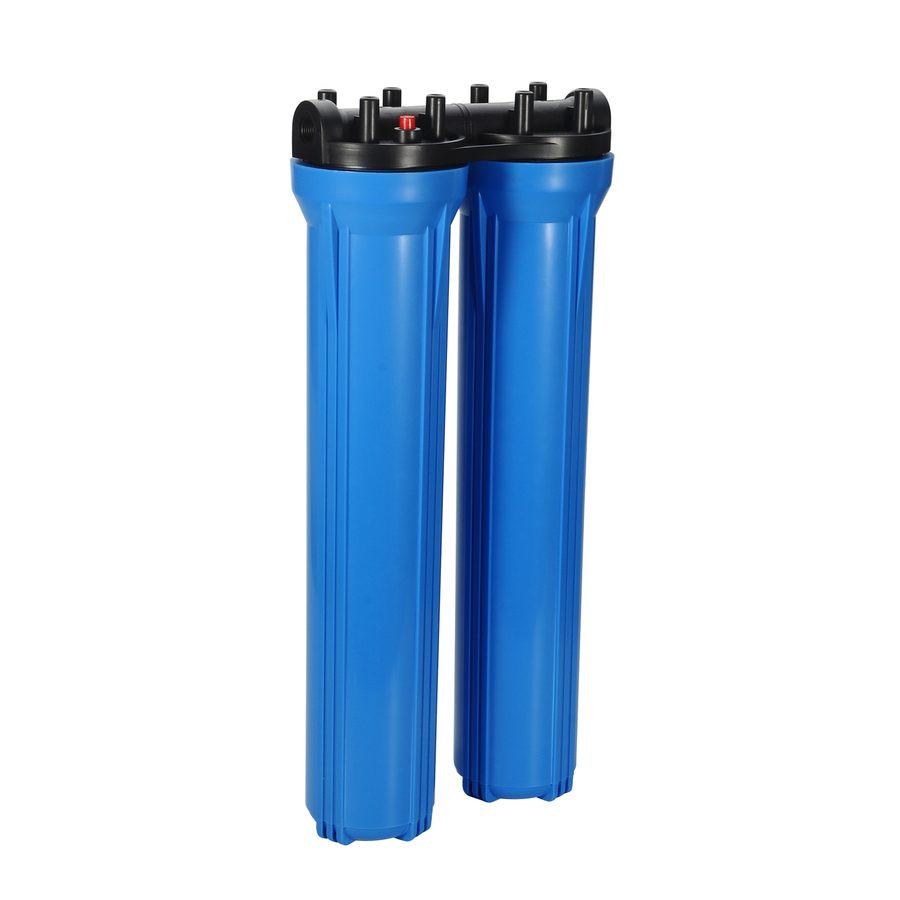
Short answer: a water filter housing is chosen by three things — cartridge size, port thread and pressure rating. A 10” slim housing takes a 2.5” × 9.75” cartridge for point-of-use and under-sink filtration (about 1-2 GPM). A Big Blue housing takes a 4.5”-diameter cartridge in 10” or 20” lengths for whole-house and light commercial flow (about 4-8 GPM). A clear housing is usually a slim or Big Blue body moulded in transparent SAN so users can see sediment build-up. For distributors and private-label brands, the details that cause returns are the thread standard (NPT vs G/BSP) and an untested pressure rating — not the size.
This guide compares the three housing families, explains how to read a housing data sheet, and covers what to put on an OEM order, including MOQ, mould tooling and lead time.
Key takeaways
- Slim and Big Blue are separate families. A 2.5” cartridge in a 4.5” housing will not seal and water bypasses the media.
- Order the port thread for the market: NPT for North America, G/BSP for most other regions.
- Clear SAN housings sell well as sediment stages; opaque PP/ABS housings are the safer choice outdoors and where light could encourage algae.
- At our factory custom housings start at 500 pcs, with 15-20 days on an existing mould and 35-45 days when a new mould is needed.
Water Filter Housing Sizes at a Glance
Most screw-cap (sump) housings sold worldwide fall into two diameter families, each in two lengths. The cartridge dimensions below are the industry convention and match our cartridge size chart.
| Housing type | Cartridge it takes (D × L) | Typical flow | Typical ports | Where it is used |
|---|---|---|---|---|
| 10” slim (standard) | 2.5” × 9.75” | 1-2 GPM | 1/4”, 3/8”, 1/2”, 3/4” | Under-sink, countertop, RO pre-filters, point of use |
| 20” slim | 2.5” × 19.75” | 1-2 GPM | 1/2”, 3/4” | Longer contact time on carbon, small offices |
| 10” Big Blue | 4.5” × 9.75” | 4-8 GPM | 3/4”, 1” (1-1/2” on some heads) | Whole-house sediment, well pre-filter |
| 20” Big Blue | 4.5” × 19.75” | 4-8 GPM | 1”, 1-1/2” | Whole-house carbon, light commercial, restaurants |
Flow figures are typical for the cartridge format; the real figure depends on the media and micron rating. A 1-micron carbon block in a slim housing will flow far less than a 20-micron PP melt-blown cartridge in the same housing.
Clear housings are not a separate size. “Clear” describes the sump material, and clear sumps exist for both slim and Big Blue formats. Treat them as a material choice, covered below.
Big Blue vs 10” Slim: Which Housing Fits the Job?
The decision comes down to flow and how often the end user is willing to change cartridges.
| Factor | 10” slim | Big Blue (10” / 20”) |
|---|---|---|
| Media volume | Small | About 3× a slim cartridge of the same length (4.5” vs 2.5” diameter) |
| Flow for a whole house | Too restrictive for most homes | Designed for it |
| Cartridge change interval | Shorter | Longer for the same water and use |
| Installation space | Fits under a sink | Needs wall or utility-room space; 20” needs height for sump removal |
| Cartridge cost per change | Lower | Higher, but fewer changes |
| Typical buyer | Retail, RO and under-sink systems | Whole-house, well water, foodservice pre-treatment |
The rule of thumb: point of use → slim; point of entry → Big Blue. If a customer complains that a whole-house slim housing “kills the shower pressure”, the housing is undersized, not faulty.
For a broader comparison of screw-cap housings and push-fit cartridges, see quick-connect vs standard housing water filters.
Looking for a reliable water filter manufacturer?
Get free samples and a factory-direct quote. MOQ from 500 pcs.
Get a Free Quote →Clear vs Opaque Housings: Materials Compared
The sump material decides chemical resistance, light exposure and how the product looks on a shelf. The materials we mould and fabricate housings in are food-grade PP, ABS, SAN for clear units, and 304/316 stainless steel.
| Material | Look | Strengths | Watch out for |
|---|---|---|---|
| SAN (clear) | Transparent | User can see sediment loading; popular first stage | Keep out of direct sunlight; avoid solvents and harsh cleaners; check temperature limit |
| PP (opaque) | White / blue / black | Good chemical resistance, blocks light, low cost | Less visual “proof” for the end user |
| ABS (opaque) | Glossy, takes colour well | Rigid, good surface finish for branded products | Check chemical compatibility with the cleaning routine |
| 304/316 stainless | Metal | High strength, commercial look, heat tolerant | Higher cost; specify 316 where chlorides are high |
A common retail configuration is a clear sediment stage followed by opaque carbon stages: the buyer sees the dirty PP cartridge and is reminded to replace it, while the carbon housings stay protected from light.
Port Threads: The Most Common Cause of Leaks
The cartridge size is easy to get right. The port thread is where orders go wrong. North America uses NPT (tapered); most of Europe, the Middle East, Asia and Russia use BSP / G threads. A G-threaded port will start on an NPT fitting and then leak under pressure.
What to state on a housing order:
- Thread standard and size — for example “1” NPT female, inlet and outlet”.
- Inlet/outlet direction marked on the head.
- Bracket and pressure-release button if the market expects them.
- O-ring material for the sump seal.
Our water filter thread standards guide has the full NPT vs BSP chart in millimetres and the wording to use on a purchase order.

How to Read a Housing Data Sheet
Before you list a housing, check that the supplier’s data sheet states at least:
- Rated maximum working pressure and the test pressure behind it. Our housings are pressure-tested to 1.5× rated working pressure; ask any supplier how and how often they test.
- Maximum water temperature. Cold-water housings are not designed for hot-water lines.
- Cartridge size accepted (2.5” or 4.5”, 10” or 20”) and the end-cap type — DOE (double open end) or SOE.
- Port thread (NPT or G) and size.
- Materials of sump, head and O-ring, and the food-contact documentation for them.
- Spanner and bracket included or not — a small detail that drives a lot of customer-service email.
If the housing will be sold with a cartridge as a system, test the pair together: fit, leak-free seal and flow on your actual housing, before volume orders.
OEM and Private-Label Housings: MOQ, Moulds and Lead Time
Distributors usually start on an existing mould with their own colour, logo and packaging, then move to a new mould once volumes justify a unique design. These are the terms from our OEM manufacturing page:
| Order type | MOQ | Lead time |
|---|---|---|
| Custom filter housings, existing mould | 500 pcs | 15-20 days |
| Custom filter housings, new mould | 500 pcs | 35-45 days |
| New mould tooling | — | Design 5-7 days, fabrication 25-35 days; first-article samples within 40 days of drawing approval |
Mould cost depends on complexity and is typically USD 3,000-15,000. Housing types we produce include Big Blue 10” and 20”, standard slim housings, clear housings, high-flow commercial housings, stainless steel housings and FRP pressure vessels. Branding options include laser or thermal logo printing on the housing, custom packaging, barcodes and multi-language labels.
Because the housing defines which cartridges fit, a private-label housing is also the start of a replacement-cartridge business. Pair it with matching standard and commercial cartridges and, for under-sink systems, with our residential filtration systems. For RO systems, plan the refill cycle with our RO filter replacement schedule.
Next step: send the housing type, cartridge size, thread standard, target market and annual volume through our quote form. We will confirm whether an existing mould fits and quote MOQ and lead time.
Related Guides
Frequently Asked Questions
- What is the difference between a Big Blue and a standard 10-inch water filter housing?
- Diameter and flow. A standard (slim) 10-inch housing takes a cartridge about 2.5 inches across and 9.75 inches long and is used for point-of-use and under-sink filtration at roughly 1-2 GPM. A Big Blue housing takes a 4.5-inch-diameter cartridge (10 or 20 inches long), carries roughly 4-8 GPM and is the usual choice for whole-house and light commercial pre-treatment. The two are not interchangeable: a slim cartridge in a Big Blue housing will not seal and water bypasses it.
- Are clear water filter housings worse than opaque ones?
- Not for filtration, but they suit different places. Clear housings, usually moulded in SAN, let users see when a sediment cartridge is loaded, which is why they are popular as the first stage. Opaque PP or ABS housings block light, so they are preferred outdoors or where algae growth is a risk, and they are generally more forgiving of chemicals and impact. Whatever the material, check the rated maximum pressure and temperature on the data sheet.
- Which thread do I need on a water filter housing for the US market?
- US plumbing uses NPT tapered threads, so a housing for North America should be ordered with NPT ports (for example 3/4" or 1" NPT on a Big Blue, 1/4"-3/4" on a slim housing). Most of Europe, the Middle East, Asia and Russia use BSP / G threads. A G-threaded port will start on an NPT fitting but will not seal reliably, so state the thread standard on the purchase order.
- What is the MOQ for custom or private-label filter housings?
- At our Ningbo factory custom filter housings start at 500 pcs. On an existing mould the lead time is 15-20 days; if a new mould is needed it is 35-45 days, with mould design taking 5-7 days and mould fabrication 25-35 days. Mould cost depends on complexity and is typically USD 3,000-15,000. Logo printing on the housing (laser or thermal) and custom packaging are available.
- Do I need a 10-inch or a 20-inch Big Blue housing?
- The 20-inch Big Blue holds twice the media of the 10-inch version, so it lasts longer between changes and gives more contact time for carbon. Choose 20-inch for whole-house carbon and for sites with high water use; 10-inch Big Blue is common for sediment pre-filters and where installation height is limited.
Looking for OEM Water Filter Cartridges?
Get a factory-direct quote from Ningbo XZH — 15+ years OEM experience, 50+ export markets, MOQ from 500 pcs.
Get a Free Quote →Get Our Full Product Catalog
100+ SKUs with specs, MOQ, and factory-direct wholesale pricing — everything covered in this article and more.