Blog ·
Bubble Tea Shop Water Filtration: OEM Cartridge Sourcing Guide for Franchise Buyers
Water filter systems for bubble tea and boba shops — TDS/hardness targets for tea steeping, flow-rate sizing, and OEM cartridge sourcing at 30-50% below branded pricing. MOQ from 500 pcs, NSF certified.
A bubble tea shop pours more filtered water per day than most coffee bars — every batch of black or oolong tea base, every scoop of chunk ice, and every syrup dilution runs through the same filter line. Coffee has the Specialty Coffee Association setting a widely quoted 75-250 ppm TDS target. Tea doesn’t have an equivalent body, which is exactly why so many multi-location bubble tea chains end up with wildly inconsistent flavor between stores — one location’s tap water clouds the tea base, another’s strips all the color out of the same brew.
This guide covers the water chemistry that actually changes bubble tea flavor and clarity, how to size a filtration system for single-station shops versus high-volume flagship stores, and how OEM cartridge sourcing works for franchise buyers standardizing filtration across dozens or hundreds of locations.
Why Water Chemistry Changes Bubble Tea Flavor and Clarity
Tea extraction is more sensitive to water hardness than coffee extraction, because tea polyphenols bind to calcium and magnesium ions differently than coffee’s oil-soluble compounds do. Three variables matter most for bubble tea specifically:
- Hardness (calcium + magnesium as CaCO3) — At 17-68 ppm, tannins extract cleanly and the tea base stays clear. Above roughly 120 ppm, dissolved calcium binds with tea polyphenols to form a visible haze — this is the cloudy, sometimes oily-looking film that shows up on iced milk tea within minutes of pouring, not a sign of spoiled ingredients. Below about 10 ppm, extraction is thin and the tea tastes flat and slightly bitter because there aren’t enough minerals to round out the tannins.
- Chlorine — Municipal chlorine at even 0.3-0.5 ppm produces a detectable off-taste in brewed tea, more noticeable than in coffee because tea has a lighter flavor base to mask it. Target below 0.1 ppm at the tap, matching the human taste-detection threshold.
- TDS (total dissolved solids) — 50-150 ppm is the practical working range for most tea styles; black tea and roasted oolong tolerate the upper end better, while lighter green and white tea bases show mineral flavor faster and do better closer to 50-90 ppm.
Target Water Parameters for Bubble Tea Brewing
| Parameter | Too Low | Ideal Range | Too High | Effect if Out of Range |
|---|---|---|---|---|
| Hardness (CaCO3) | Below 10 ppm | 17-68 ppm | Above 120 ppm | Low = flat, bitter, poor color. High = cloudy base, oily film on iced drinks |
| TDS | Below 30 ppm | 50-150 ppm | Above 250 ppm | Low = watery, no body. High = muddy, inconsistent batch-to-batch flavor |
| Free chlorine | — | 0 ppm (non-detect) | Above 0.1 ppm | Chemical/pool-water off-taste, more noticeable in tea than coffee |
| pH | Below 6.0 | 6.5-7.5 | Above 8.0 | Low = sour, unstable tannins. High = dull color, faster tea-base oxidation |
Filtration Technology Stack for a Bubble Tea Station
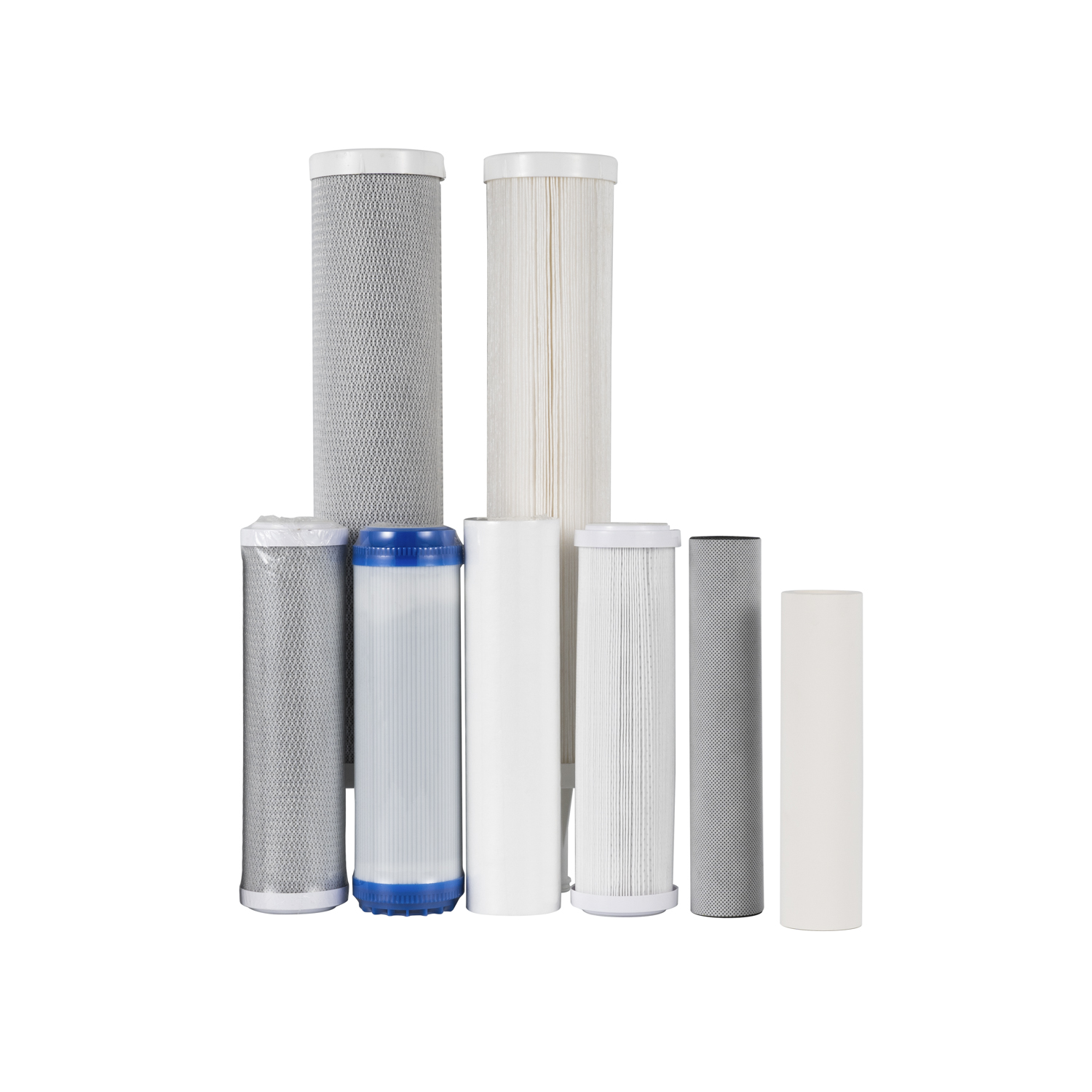
Most bubble tea shops need a two- to three-stage under-counter setup rather than a single cartridge, because sediment, chlorine, and hardness each need a different filtration mechanism:
- PP sediment pre-filter (5-20 micron) — Protects downstream media and the ice maker’s solenoid valve from sand, rust, and scale particles in municipal supply lines. Sized generously (20 micron) to avoid slowing flow into the ice maker.
- Coconut-shell CTO carbon block filter (0.5-1 micron) — The core taste stage. Removes chlorine, chloramine, and organic taste/odor compounds. Coconut-shell carbon with an iodine value of 1,000+ mg/g outperforms cheaper coal-based carbon (typically 600 mg/g) on both chlorine capacity and cartridge lifespan.
- scale inhibitor filters or partial RO (hard-water regions only) — Polyphosphate dosing sequesters calcium and magnesium so they don’t precipitate as scale in ice makers and tea brewing urns. Where source water is genuinely hard (above 120-150 ppm), a partial RO stage with mineral-blend remineralization brings TDS into range without stripping the water flat.
Filter Stage Comparison for Bubble Tea Applications
| Stage | Micron / Spec | Function | Typical Lifespan |
|---|---|---|---|
| PP sediment | 5-20 micron | Particulate & rust removal, protects ice maker valves | 3-4 months (heavy sediment areas) |
| Coconut-shell carbon block | 0.5-1 micron | Chlorine/chloramine removal, taste & odor | 2,500-9,000 gallons (4-6 months typical) |
| Scale inhibitor (polyphosphate) | Inline dosing cartridge | Prevents calcium scale in urns & ice makers | 4-6 months, co-timed with carbon block |
| Partial RO + remineralization | 50-75% rejection | Reduces TDS/hardness in hard-water regions | Membrane 12-24 months, pre-filters 3-6 months |
Standardizing filtration across a bubble tea chain?
Get free samples and factory-direct pricing for multi-location programs. MOQ from 500 pcs.
Get a Free Quote →Looking for a reliable water filter manufacturer?
Get free samples and a factory-direct quote. MOQ from 500 pcs.
Get a Free Quote →Sizing a Filtration System by Shop Volume
Flow rate is the variable most first-time bubble tea franchise buyers get wrong, because a single-station shop and a flagship store with a dedicated cold-brew line have very different peak demand:
| Shop Profile | Daily Cup Volume | Minimum Flow Rate | Recommended Setup |
|---|---|---|---|
| Single station, no dedicated ice maker | Under 150 cups/day | 1.0-1.2 GPM (3.8-4.5 LPM) | Single 10” carbon block + PP pre-filter |
| Single station + chunk ice maker | 150-300 cups/day | 1.5-1.8 GPM (5.7-6.8 LPM) | 20” high-flow carbon block + PP pre-filter |
| Two stations (tea + sealing machine + ice maker) | 300-400 cups/day | 1.8-2.0 GPM (6.8-7.6 LPM) | Twin-cartridge parallel manifold |
| Flagship / high-volume store with RO line | 400+ cups/day | 2.5+ GPM (9.5+ LPM) | Twin-cartridge carbon + dedicated partial RO branch |
Undersized filters cause a pressure drop that shows up first at the ice maker — slower fill cycles and, eventually, inconsistent ice production during peak afternoon and evening rushes. Always size for peak demand plus a 20% safety margin, the same rule we apply when sizing commercial coffee machine filtration, because both applications share a peak-hour bottleneck problem rather than a steady average-flow problem.
When Bubble Tea Chains Actually Need RO
Reverse osmosis is not a default requirement — for shops on soft-to-moderate municipal water (under 150 ppm TDS), a well-sized carbon and scale-inhibitor stack is enough, and it costs less to install and maintain across dozens of locations. RO becomes necessary when:
- Source water hardness consistently exceeds 120-150 ppm, common in parts of the Middle East, inland limestone-belt cities in Southeast Asia, and some municipal supplies in northern China
- A franchise wants flavor consistency across locations with genuinely different source water quality, and is willing to standardize on RO + remineralization everywhere to guarantee it
- The shop also runs a cold-brew or specialty tea line where TDS consistency at the low end (50-90 ppm) matters more than for standard milk tea
The mistake to avoid: installing RO without a remineralization cartridge. Straight RO permeate runs close to 0 ppm TDS, and tea brewed with it tastes flatter and less flavorful than tea brewed with properly filtered but non-RO tap water — the same lesson we cover in more depth in our RO vs UF comparison guide for buyers deciding between membrane technologies.
OEM Cartridge Sourcing for Multi-Location Bubble Tea Chains
For distributors and franchise procurement teams standardizing filtration across 10, 50, or 200+ locations, cartridge sourcing is the largest recurring line item in the water program — replacement cycles run every 4-6 months per location, which compounds fast at scale.
Branded vs. OEM Cost Comparison (10-inch Coconut-Shell Carbon Block, FOB Ningbo)
| Order Volume | Branded Everpure/3M Equivalent | OEM-Compatible Cartridge | Savings |
|---|---|---|---|
| Single shop (2-3 cartridges/yr) | $3.50-5.00 each (retail/distributor) | $0.60-0.95 each (1,000 pcs FOB) | ~75-80% |
| 50-location chain (150 cartridges/yr) | $525-750/yr | $90-140/yr at 5,000+ pcs pricing | $400-600/yr |
| 200-location chain (600 cartridges/yr) | $2,100-3,000/yr | $340-500/yr at 10,000+ pcs pricing | $1,700-2,500/yr |
These per-cartridge FOB prices track the same GAC and CTO pricing bands published in our 2026 China filter cartridge price guide — branded retail comparisons above use standard third-party distributor pricing for the equivalent Everpure/3M platform cartridge, not our own product, so treat them as a reference range rather than a quote.
Standard OEM cartridges with your logo applied to an existing mold start at 500-1,000 pieces per SKU. Fully custom cartridges — your own housing dimensions, a custom carbon blend tuned for a signature tea flavor profile, or a proprietary connector matched to your equipment supplier — require 3,000-5,000 pieces because of tooling cost. For franchise buyers who want to test taste and flow performance before committing to a full production run, most factories including ours offer trial orders of 200-500 pieces at a modest per-unit premium.
A private-label program is also a natural fit here: bubble tea franchises already sell branded cups, straws, and packaging, and a co-branded filter cartridge reinforces the “we control water quality at every location” message to franchisees — a differentiator that’s hard to copy quickly. Our private-label sourcing guide covers how to structure that program, from mold ownership to minimum reorder quantities.
Certification & Food-Safety Requirements
Bubble tea shops are food-and-beverage operations, so filtration certification requirements track those of restaurants and cafes rather than residential water treatment:
- NSF/ANSI 42 — Chlorine taste and odor reduction. This is the baseline certification because chlorine removal is the single biggest lever on tea taste.
- NSF/ANSI 53 — Health contaminant reduction (lead, cysts). A useful add-on where local water testing shows documented issues, but not universally required.
- CE marking — Required for housings and cartridges sold into EU franchise locations.
- Halal certification — Relevant for franchise buyers in Halal-market countries; request documentation covering cartridge media and housing materials, not just the finished product label.
- ISO 9001 — A factory-level quality management certification that indicates consistent manufacturing, not a claim about the cartridge’s filtration performance itself.
Ask any prospective OEM manufacturer for their NSF/ANSI 42 test report and, ideally, a look at their in-house testing lab before signing a multi-location supply agreement — a trading company reselling someone else’s cartridges typically can’t produce either on request. For a full breakdown of which certification actually matters for which market, see our NSF 42 vs 53 vs 401 explainer.
Installation & Maintenance for Multi-Location Operators
Replace cartridges at rated gallon capacity or every 4-6 months, whichever comes first — this is shorter than the 6-12 month interval typical of coffee-only cafes because bubble tea stations push more total water volume per day through combined tea brewing and ice production. A standard 2,500-gallon coconut carbon cartridge covers roughly 200-250 cups/day of combined output before flow rate and taste performance start to degrade; high-volume stores above 400 cups/day should run 6,000-9,000 gallon high-capacity cartridges or a twin-cartridge parallel system instead of doubling replacement frequency.
For chains running Everpure-platform bayonet housings shared with an espresso station, our Everpure replacement schedule guide covers model-specific capacity ratings (4FC at 6,000 gallons, MC2 at 2,500 gallons, H-300 at 9,000 gallons) that apply directly to a shared coffee-and-tea filtration setup. Installing a mechanical or electronic flow meter on the inlet line — rather than relying on a fixed calendar schedule — is the single change that prevents both premature cartridge waste and overdue changes that let scale reach the ice maker.
Related Guides
- Commercial Coffee Machine Water Filter — Scale Prevention & Flow Rate Guide
- RO vs UF Water Purification: Which One Do You Need?
- How to Start a Private-Label Water Filter Brand
- Everpure Water Filter Replacement Schedule Guide
- NSF 42 vs 53 vs 401 Certifications Explained
- Water Filter Cartridge Price Guide 2026: FOB vs CIF vs Landed Cost
Talk to the Factory
XZH manufactures PP sediment, coconut-shell carbon block, quick-connect, and Everpure-compatible cartridges in Ningbo, with private-label packaging and NSF/ANSI 42 test documentation available for franchise procurement teams standardizing filtration across multiple locations.
Send us your source water test results (or ask us how to get one done) and your per-location cup volume, and we’ll come back with a flow-rate-sized filter spec, FOB quotation, and sample plan. Contact our sales team or review our OEM manufacturing capabilities.
Frequently Asked Questions
- What water quality does a bubble tea shop actually need?
- Target 50-150 ppm TDS, 17-68 ppm hardness (as CaCO3), zero detectable free chlorine, and neutral pH (6.5-7.5). This is a narrower and lower band than commercial coffee (which tolerates 75-250 ppm TDS). Water outside this range shows up directly in the cup: above roughly 120 ppm hardness the tea base turns cloudy and an oily film forms on iced drinks; below about 10 ppm hardness the tea tastes flat, bitter, and loses color extraction. There is no single certifying body for tea water the way NSF or the SCA sets thresholds for coffee, so these figures come from cross-referencing tea-industry brewing guidance with our own cartridge performance data on chlorine and TDS reduction.
- Do bubble tea shops need reverse osmosis, or is carbon filtration enough?
- It depends on source water hardness. If municipal water tests below 150 ppm TDS and below 68 ppm hardness, a two-stage PP sediment + coconut-shell carbon block setup is sufficient — this is what roughly 70% of our bubble tea shop and franchise orders ship with. Above that, especially in hard-water regions (parts of the Middle East, Southeast Asia limestone-belt cities, and inland China), a partial RO stage with mineral-blend remineralization is needed to bring TDS down into range without stripping the water completely flat. RO-only output without remineralization (near 0 ppm TDS) tastes worse for tea than unfiltered tap water in most side-by-side cupping tests.
- What filter flow rate does a bubble tea shop need?
- Size for peak-hour demand, not daily average. A single-station shop brewing tea plus using a chunk ice maker needs a minimum 1.0-1.2 GPM (3.8-4.5 LPM) filtered line. A two-station shop with a sealing machine and dedicated ice maker needs 1.8-2.0 GPM. High-volume flagship stores running 400+ cups per day with a separate RO line for syrup dilution should size for 2.5+ GPM with a twin-cartridge parallel manifold so peak service doesn't starve the ice maker of flow. Undersizing is the most common installation mistake we see from first-time franchise buyers — it doesn't just slow the tap, it drops line pressure enough to affect ice maker fill cycles.
- Can I use Everpure-compatible OEM cartridges in a bubble tea shop filtration line?
- Yes, for shops already running Everpure-platform bayonet-head housings (4FC, MC2, H-300, 2FC) shared with an espresso or drip-coffee station. The bayonet interface is a cross-manufactured industry standard, and OEM-compatible cartridges built on the same coconut-shell carbon block media perform equivalently at 30-50% lower cost. For shops without existing Everpure hardware, we typically recommend standard 10-inch or 20-inch quick-connect housings instead — they cost less to install new and are easier to service across multiple franchise locations without needing branded-platform compatibility.
- What's the MOQ and cost for private-label bubble tea filtration cartridges?
- Standard OEM cartridges with your label applied to an existing mold start at 500-1,000 pieces per SKU, priced from $0.70-1.10 for a 10-inch standard carbon block and $0.60-0.95 for coconut-shell GAC media, FOB Ningbo. Fully custom cartridges — your own housing dimensions, custom carbon blend for a signature flavor profile, or a proprietary connector — require 3,000-5,000 pieces due to tooling cost. We also run trial orders of 200-500 pieces at a modest per-unit premium so new franchise buyers can validate taste and flow performance before committing to a full production run.
- How often should a bubble tea shop replace its water filter cartridges?
- Replace at rated gallon capacity or every 4-6 months, whichever comes first — shorter than the 6-12 month interval typical for coffee-only operations, because bubble tea stations run more total water volume per day through both tea brewing and ice production. A standard 2,500-gallon coconut carbon cartridge covers roughly 200-250 cups/day of combined tea and ice output before capacity or flow rate degrades. High-volume locations running 400+ cups should install 6,000-9,000 gallon high-capacity cartridges or a twin-cartridge parallel system, and add a mechanical flow meter so replacement is triggered by actual usage instead of a fixed calendar date.
- What certifications should I require from a bubble tea filtration OEM manufacturer?
- NSF/ANSI 42 (chlorine taste and odor reduction) is the baseline requirement since chlorine removal is the primary driver of tea taste quality. NSF/ANSI 53 is a useful add-on if local water has documented lead or cyst issues. For franchise operations exporting to the EU, request CE-marked housings; for Halal-market franchise buyers, request the factory's Halal certification for cartridge media and housing materials, since some tea and dairy-adjacent product lines require full supply-chain Halal documentation. ISO 9001 on the factory itself, plus an in-house testing lab that can run chlorine-reduction challenge tests, is what separates a manufacturer from a trading company reselling someone else's cartridges.
Looking for OEM Water Filter Cartridges?
Get a factory-direct quote from Ningbo XZH — 15+ years OEM experience, 50+ export markets, MOQ from 500 pcs.
Get a Free Quote →Get Our Full Product Catalog
100+ SKUs with specs, MOQ, and factory-direct wholesale pricing — everything covered in this article and more.