
Blog ·
Ice Machine Water Filter Sizing Guide: Flow Rate, Capacity & OEM Solutions
Size the right ice machine water filter by machine type, flow rate, and daily capacity. Cube vs nugget vs flake requirements, scale inhibitor dosing, and OEM cartridge sourcing at MOQ 500.
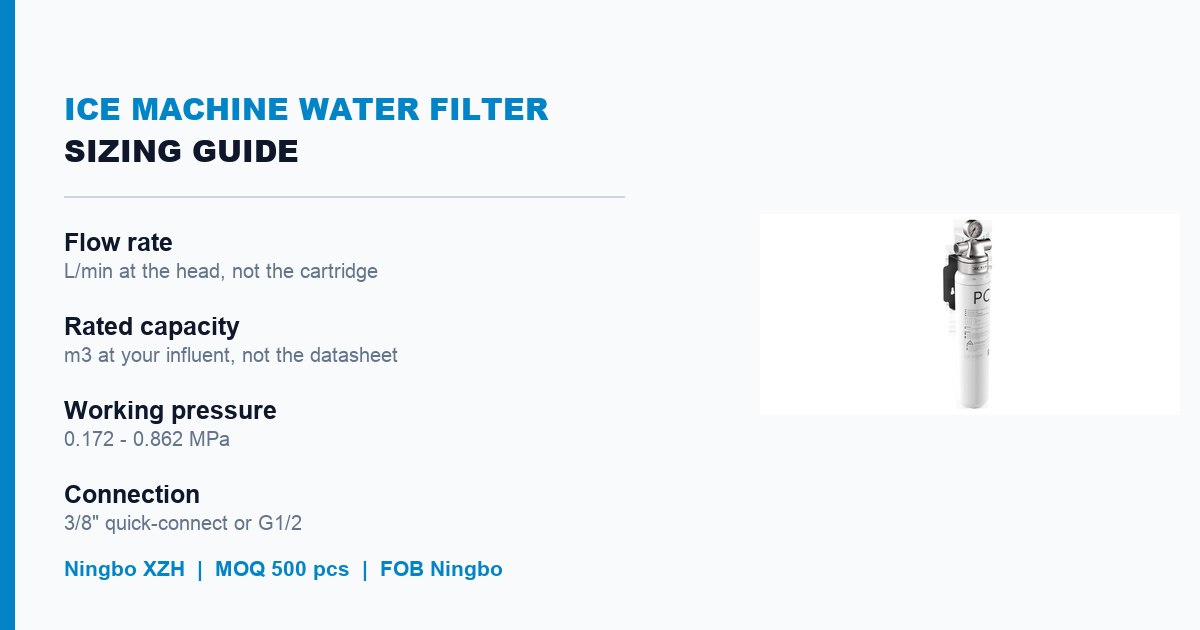
Quick answer: Match the filter to three numbers — the machine’s peak inlet flow rate (0.5-3.0 GPM depending on production capacity), the daily water consumption (roughly 1 gallon per 8-10 lb of cube ice, 1 gallon per 5-7 lb of flake/nugget ice), and your target replacement interval (typically 6 months). Get any one of those wrong and you end up with undersized cubes, cloudy ice, premature scale, or nuisance fault codes. This guide walks through the sizing math for every common machine type, explains why nugget and flake machines need different media than cubers, and shows how OEM-manufactured cartridges from XZH deliver the same protection at 30-50% below branded cartridge pricing.
We build ice machine filter cartridges for distributors and equipment OEMs in 40+ countries. The sizing mistakes we correct most often are not exotic — they are basic mismatches between the cartridge’s rated capacity and the machine’s actual water demand. This guide gives you the data to avoid those mismatches.
Why Ice Machines Are a Distinct Filtration Application
A commercial ice machine is not a faucet, a coffee brewer, or a dishwasher. Its filtration requirements sit in a unique middle ground:
- Ice is classified as food by the FDA, so the water feeding the machine must meet drinking-water standards — NSF/ANSI 42 at minimum, NSF/ANSI 53 where local code requires pathogen reduction.
- Scale accumulates on the evaporator, not in a boiler. A 1/8-inch layer of calcium carbonate on evaporator plates reduces ice production by 30-40% and increases compressor energy consumption by 20-25%.
- Water chemistry is visible in the product. Cloudy cores, white flaking, and off-taste ice are immediate customer complaints — unlike scale inside a boiler, which fails silently for months before anyone notices.
- Flow is intermittent, not continuous. The inlet valve opens for 60-90 seconds per freeze cycle, draws water at peak flow, then closes. The filter must handle that burst without dropping pressure below the machine’s minimum (typically 20 psi).
These constraints mean you cannot simply repurpose a coffee filter or a drinking-water cartridge and expect it to perform. You need a cartridge sized specifically for the ice machine’s water demand profile.
Ice Machine Types vs. Filter Requirements
Not all ice machines use water the same way. The freezing mechanism determines which filter media is safe to use, how much water the machine consumes per pound of ice, and whether a scale inhibitor is appropriate.
| Parameter | Cube Ice (Standard / Crescent / Dice) | Nugget Ice (Cubelet / Chewable) | Flake Ice |
|---|---|---|---|
| Freezing method | Water flows over evaporator plate; minerals rejected to sump; sump flushed to drain | Auger freezes all incoming water into cylinder; shears into pieces | Auger freezes all incoming water onto drum; scrapes into flakes |
| Water use per lb of ice | ~0.10-0.13 gal/lb (with flush water) | ~0.14-0.20 gal/lb (no flush cycle) | ~0.14-0.20 gal/lb (no flush cycle) |
| TDS target (feed water) | < 300 mg/L preferred; < 500 mg/L maximum | < 200 mg/L preferred (all TDS ends up in ice) | < 200 mg/L preferred |
| Scale inhibitor (phosphate) | Yes — phosphate exits via flush water | No — phosphate ends up in ice (taste/health issue) | No — same reason as nugget |
| Recommended media | Carbon block + polyphosphate scale inhibitor | Carbon block only (or carbon + upstream softener) | Carbon block only (or carbon + upstream softener) |
| Minimum micron rating | 1 µm (NSF 53 cyst reduction) | 1 µm | 1 µm |
| Typical flow rate demand | 0.5-2.0 GPM | 0.5-1.5 GPM | 0.5-1.5 GPM |
The critical takeaway: never install a phosphate-dosing cartridge on a nugget or flake machine. The polyphosphate has nowhere to go except into the finished ice, producing a soapy or metallic off-taste at concentrations above 3-5 mg/L and potentially triggering health-code scrutiny. This is the single most common specification error we see in field installations.
Looking for a reliable water filter manufacturer?
Get free samples and a factory-direct quote. MOQ from 500 pcs.
Get a Free Quote →Sizing Table: Machine Capacity vs. Minimum Filter Capacity
Use this table to select the correct cartridge capacity based on your machine’s rated daily production. The calculations assume a 6-month replacement target on municipal water at 7-10 grains per gallon hardness. Derate by 30-40% for water above 15 grains.
| Machine Capacity (lb/day) | Ice Type | Est. Daily Water Use (gal) | 6-Month Capacity Needed (gal) | Recommended Cartridge Size | Example Flow Rate (GPM) |
|---|---|---|---|---|---|
| 80-150 | Cube | 10-19 | 1,800-3,420 | 4,000 gal (2.5”x10” single) | 0.5 |
| 150-300 | Cube | 19-38 | 3,420-6,840 | 7,500 gal (2.5”x10” high-cap) | 0.75-1.0 |
| 300-600 | Cube | 38-78 | 6,840-14,040 | 15,000 gal (2.5”x20” or dual) | 1.0-1.5 |
| 600-1,000 | Cube | 78-130 | 14,040-23,400 | 25,000 gal (dual-cartridge system) | 1.5-2.0 |
| 1,000-2,000 | Cube | 130-260 | 23,400-46,800 | 50,000 gal (dual high-cap or triple) | 2.0-3.0 |
| 200-500 | Nugget/Flake | 29-100 | 5,220-18,000 | 10,000-18,000 gal (carbon only) | 0.75-1.5 |
| 500-1,000 | Nugget/Flake | 100-200 | 18,000-36,000 | 25,000-35,000 gal (carbon only, dual) | 1.0-2.0 |
These are planning figures. Always cross-reference with the machine manufacturer’s specified inlet flow rate and minimum operating pressure — if the cartridge’s rated service flow at 15 psi pressure drop is lower than the machine’s peak draw, step up to a larger housing diameter or a dual-cartridge manifold.
Carbon Block Micron Ratings: Choosing the Right Porosity
The carbon block is the working core of every ice machine filter. Its micron rating determines what it traps and how much flow it can deliver.
| Micron Rating | Particle Removal | Chlorine Reduction | Cyst Reduction (NSF 53) | Max Service Flow (2.5”x10”) | Best Application |
|---|---|---|---|---|---|
| 0.5 µm | Sub-micron sediment, bacteria barrier | > 97% at rated flow | Yes | 0.5-1.0 GPM | Low-volume undercounter machines; applications requiring maximum particulate protection |
| 1 µm | Cryptosporidium, Giardia cysts, fine sediment | > 95% at rated flow | Yes | 1.0-1.5 GPM | Most commercial ice machines — best balance of protection and flow |
| 5 µm | Visible sediment, rust, sand | > 85% at rated flow | No (cysts are 3-7 µm) | 1.5-2.5 GPM | Pre-filter stage only; not suitable as sole filtration for ice contact |
For the majority of commercial ice machine installations, 1-micron coconut-shell carbon block is the right choice. It meets NSF/ANSI 42 + 53 requirements, delivers adequate flow for machines up to 600 lb/day in a single 2.5”x10” cartridge, and removes chlorine taste and odor that would otherwise transfer directly into the ice. Step down to 0.5 µm only when local water quality or health-code requirements demand it, and accept the flow-rate penalty. Step up to 5 µm only as a sediment pre-filter upstream of the main carbon stage.
Scale Inhibitor Chemistry: When and How to Dose
Scale is the number-one enemy of ice machine longevity. Calcium and magnesium precipitate on evaporator surfaces as water temperature drops during freezing, forming a hard carbonate layer that insulates the evaporator, extends freeze-cycle time, and eventually triggers mechanical failure.
Three approaches to scale control, in order of increasing cost and complexity:
1. Polyphosphate dosing (integrated in cartridge) — The simplest solution for cube ice machines on water up to 12-15 grains hardness. A food-grade polyphosphate crystal or bead slowly dissolves into the water stream at 2-5 mg/L, sequestering calcium ions and preventing them from precipitating on cold surfaces. Effective, inexpensive, and zero-waste. But never for nugget or flake machines — the phosphate ends up in the ice.
2. Upstream ion-exchange softener — Removes calcium and magnesium entirely by exchanging them for sodium. Works for all machine types including nugget and flake. Adds sodium to the water (typically 15-25 mg/L per grain of hardness removed), which has no taste impact in ice. Requires periodic salt regeneration. Best for sites with very hard water (> 15 grains) or where a single softener serves multiple ice machines.
3. Reverse osmosis pre-treatment — Removes 95-98% of all dissolved solids. Produces extremely clear ice with zero scale risk. Overkill for most applications and produces 2-4 gallons of reject water per gallon of permeate. Reserve for premium clear-ice applications or where feed water exceeds 500 mg/L TDS.
For most commercial foodservice sites running cube machines on municipal water at 5-12 grains hardness, a carbon block cartridge with integrated polyphosphate is the correct, cost-effective answer. For sites with nugget or flake machines, pair a carbon-only cartridge with an upstream softener if hardness exceeds 7 grains.
Pressure Drop and Flow: The Hidden Sizing Constraint
A filter cartridge that meets your capacity requirement can still fail the application if it cannot deliver adequate flow at acceptable pressure. Here is the relationship between filter restrictiveness and real-world performance:
- Machine minimum inlet pressure: Most commercial ice machines require 20-30 psi at the inlet solenoid. Below this threshold, the sump under-fills and cubes are small, hollow, or cracked. Some machines display a low-water fault code and halt production entirely.
- Municipal supply pressure: Typically 40-80 psi at the meter in most US markets.
- Clean-cartridge pressure drop: A new 1-micron 2.5”x10” carbon block drops 5-10 psi at 1.0 GPM.
- End-of-life pressure drop: As the carbon block loads with sediment and the scale-inhibitor bed compacts, pressure drop climbs. At 15-20 psi above clean-cartridge baseline, the cartridge is spent and must be replaced.
The sizing math: supply pressure minus cartridge pressure drop minus plumbing friction losses must exceed the machine’s minimum inlet pressure at peak flow. If your supply is 45 psi, your plumbing drops 5 psi, and a clean 0.5-micron cartridge drops 12 psi at peak flow, you start with only 28 psi at the machine — barely above the 20 psi minimum, with no headroom for cartridge aging. In this scenario, step up to a 1-micron cartridge (8 psi drop) or install a larger 4.5”x10” housing to increase flow area and reduce restriction.
OEM Cartridge Sourcing: Why Distributors Switch to Factory-Direct
Branded ice machine filter cartridges from equipment OEMs carry retail pricing of USD 45-120 per cartridge. The cartridge inside — coconut-shell activated carbon block, food-grade polyphosphate beads, polypropylene end caps, O-ring seal — is a commodity manufactured in a handful of ISO 9001 factories in China, including ours.
When you source equivalent OEM cartridges from XZH Water Filtration:
- 30-50% cost reduction vs. branded replacements, with identical media, dimensions, and performance certification
- NSF/ANSI 42 + 53 tested media — same coconut-shell carbon, same micron rating, same chlorine and cyst reduction claims
- Private labelling at no additional cost — your brand, your part numbers, your packaging
- Custom capacity ratings — we adjust carbon block density, polyphosphate charge weight, and housing length to match any OEM specification or to create a unique SKU for your catalog
- MOQ 500 pieces for standard 10-inch and 20-inch quick-connect and threaded formats
- Compatibility cross-referencing — we maintain dimensional and performance cross-references to Everpure, 3M/Cuno, Manitowoc, Scotsman, and Hoshizaki OEM cartridges
A 20-location restaurant group replacing two ice machine cartridges per site per year saves USD 1,000-2,500 annually by switching to factory-direct OEM cartridges — without changing housings, without re-plumbing, and without any compromise in water quality or food-safety compliance.
Replacement Scheduling: Calendar vs. Capacity vs. Condition
The standard industry recommendation — replace every 6 months — is a useful starting point but a poor finishing point. Actual cartridge life depends on three site-specific variables:
-
Feed water hardness and TDS. A cartridge rated for 15,000 gallons at 7 grains hardness may exhaust its scale-inhibitor charge in 9,000 gallons at 15 grains. Test your feed water and derate accordingly.
-
Chlorine and chloramine concentration. Municipal systems dosing 2-4 ppm chloramine exhaust carbon faster than systems dosing 0.5-1.0 ppm free chlorine. If your water utility uses chloramine (increasingly common in the US), specify catalytic carbon or plan for shorter intervals. See our chloramine removal guide for media selection details.
-
Sediment load. Well water, aging municipal mains, or construction activity upstream can clog a cartridge in weeks. Always install a dedicated sediment pre-filter upstream of the carbon stage in high-sediment environments.
Best practice for multi-unit operators: Install a differential-pressure gauge across each filter housing. Record the clean-cartridge baseline, then replace when the differential exceeds 15 psi. This approach replaces cartridges on condition rather than on a calendar, eliminates premature replacements on clean-water sites, and catches early exhaustion on problem-water sites before ice quality degrades.
For a complete foodservice replacement schedule covering ice machines, coffee, steamers, and warewashing, see our dedicated guide.
Common Sizing Mistakes and How to Avoid Them
After manufacturing ice machine cartridges for over a decade, we see the same errors repeatedly:
Mistake 1: Using a coffee filter on an ice machine. Coffee cartridges are designed for 0.25-0.5 GPM continuous flow with a focus on taste optimization. They lack the flow capacity for a 500 lb/day cuber drawing 1.5 GPM in bursts, and most do not include scale inhibition.
Mistake 2: Installing a phosphate cartridge on a nugget machine. As detailed above, the phosphate ends up in the finished ice. The customer complains about off-taste ice, the operator blames the machine, and the real cause is a filter specification error.
Mistake 3: Oversizing on capacity, undersizing on flow. A 50,000-gallon cartridge is meaningless if it cannot deliver 1.5 GPM without dropping pressure below the machine’s minimum. Capacity and flow rate are independent specifications — check both.
Mistake 4: Ignoring pre-filtration on hard water. A carbon-plus-phosphate cartridge handles moderate hardness well, but on water above 15 grains, the phosphate charge exhausts months before the carbon does. The operator thinks the filter is still good (the carbon is fine), but scale is building unchecked. Add a dedicated softener upstream.
Mistake 5: Using the same replacement interval for every site. A cartridge on 5-grain, low-sediment municipal water lasts 8-9 months. The identical cartridge on 18-grain well water may last 10 weeks. Site-specific replacement intervals, ideally driven by differential-pressure monitoring, prevent both waste and failure.
Putting It All Together: A Sizing Checklist
Before specifying an ice machine water filter for any installation:
- Identify the machine type — cube, nugget, or flake — to determine whether phosphate media is permissible
- Record the machine’s rated production (lb/day) and inlet flow rate (GPM) from the spec sheet
- Test feed water — hardness (grains per gallon), TDS (mg/L), chlorine/chloramine (ppm), and sediment level
- Calculate daily water consumption using the conversion factors in the sizing table above
- Multiply by target replacement interval (180 days for 6 months) to get minimum cartridge capacity in gallons
- Verify flow rate — the cartridge’s rated service flow must meet or exceed the machine’s peak inlet draw at no more than 10-15 psi pressure drop
- Select micron rating — 1 µm for most applications, 0.5 µm where code or water quality demands it
- Confirm certifications — NSF/ANSI 42 at minimum; add NSF 53 for cyst reduction where required
- Determine scale strategy — integrated phosphate for cube machines on moderate water; upstream softener for nugget/flake or very hard water; RO for premium clear-ice applications
- Plan replacement monitoring — calendar date, gallon meter, or differential-pressure gauge
Need help sizing a cartridge for a specific machine model or water condition? Contact our engineering team — we cross-reference to Hoshizaki, Manitowoc, Scotsman, Everpure, and 3M dimensional standards and can quote a custom or compatible OEM cartridge at MOQ 500 pieces within 48 hours.
Related: Quick-connect inline water filters (most ice machines use quick-connect fittings) | Ice machine filter product line | OEM water filter manufacturing
Frequently Asked Questions
- How do I calculate the correct filter capacity for a commercial ice machine?
- Start with the machine's rated daily production in pounds, then convert to water consumption. A cube ice machine uses roughly 1 gallon of water per 8-10 pounds of ice produced (accounting for flush water that goes to drain during each freeze cycle). A 500 lb/day cuber therefore consumes approximately 50-65 gallons of filtered water per day, or 1,500-1,950 gallons per month. Multiply that monthly figure by your target replacement interval — typically 6 months for standard municipal water — and you get the minimum cartridge capacity: 9,000-11,700 gallons. Always round up to the next standard cartridge size. Flake and nugget machines use more water per pound of ice because they operate continuous auger systems that recirculate and waste more water, so increase the multiplier to 1 gallon per 5-7 pounds of ice. If your feed water exceeds 10 grains per gallon hardness, derate the scale-inhibitor capacity by 30-40 percent and shorten the replacement interval accordingly.
- What is the difference between a 0.5 micron and a 5 micron carbon block for ice machines?
- The micron rating describes the smallest particle size that the carbon block will physically trap. A 5-micron block stops visible sediment, rust flakes, and larger cyst-form organisms but passes finer particles and most bacteria. A 1-micron block catches Cryptosporidium and Giardia cysts (both 3-7 microns) with a comfortable safety margin, which is why NSF/ANSI 53 cyst-reduction certification requires nominal 1-micron or finer media. A 0.5-micron block goes further, trapping sub-micron particulate and providing an additional barrier against bacterial breakthrough. The trade-off is flow rate and pressure drop: a 0.5-micron 2.5x10-inch cartridge typically supports 0.5-1.0 GPM before pressure drop exceeds 15 psi, while a 5-micron cartridge of the same dimensions handles 1.5-2.5 GPM at the same pressure drop. For ice machines producing under 400 lb/day with a single water inlet, 1-micron carbon is the practical sweet spot — fine enough for cyst reduction and chlorine removal, coarse enough to maintain adequate flow without triggering low-pressure fault codes on the machine.
- Can I use a phosphate scale inhibitor filter on a nugget or flake ice machine?
- No — and this is one of the most common specification errors in foodservice filtration. Phosphate-based scale inhibitors work by dosing a controlled amount of food-grade polyphosphate into the water stream. In a standard cube ice machine, the freezing process rejects dissolved solids into the circulating water, which is periodically flushed to drain; the phosphate goes out with the flush water and never ends up in the finished ice cube. Nugget and flake machines operate differently. They freeze all incoming water into a solid sheet or cylinder of ice, then an auger shears it into pieces. There is no selective rejection and no flush cycle — every dissolved substance in the feed water, including the polyphosphate, ends up in the finished ice. Customers consuming that ice ingest the phosphate, which can produce an unpleasant soapy or metallic taste at concentrations above 3-5 mg/L and may pose a health-code concern. Use a carbon-only or carbon-plus-softener approach for nugget and flake machines, never a phosphate cartridge.
- How often should a commercial ice machine water filter be replaced?
- The industry baseline is every 6 months or at rated gallon capacity, whichever comes first. However, actual replacement intervals depend on three local variables. First, feed water TDS and hardness: water above 15 grains per gallon exhausts scale-inhibitor media roughly twice as fast as water at 7 grains, so a 6-month cartridge may only last 3 months. Second, chlorine and chloramine concentration: municipal systems dosing 2-4 ppm chloramine will exhaust a standard coconut-shell carbon block faster than a system dosing 0.5-1.0 ppm free chlorine, because chloramine requires catalytic carbon or a longer contact time. Third, sediment load: well-water applications or regions with aging municipal infrastructure can clog a cartridge in weeks if no sediment pre-filter is installed upstream. Monitor differential pressure across the cartridge with a gauge — when the pressure drop exceeds 15 psi above the clean-cartridge baseline, or when ice clarity visibly degrades (cloudy cores, white flaking), replace immediately regardless of the calendar date.
- What flow rate does an ice machine water filter need to support?
- Commercial ice machines draw water in intermittent bursts during each freeze cycle, not continuously. The inlet solenoid valve opens, fills the sump or reservoir in 60-90 seconds, then closes. Peak instantaneous flow during that fill is what matters for filter sizing. Small undercounter machines (80-150 lb/day) typically draw 0.5-0.75 GPM. Mid-range cubers (200-600 lb/day) draw 1.0-1.5 GPM. Large modular heads (800-2,000 lb/day) may draw 1.5-3.0 GPM through a 3/8-inch or 1/2-inch inlet line. If the filter cannot deliver the machine's peak draw rate without dropping supply pressure below the manufacturer's minimum (usually 20 psi), the machine will either under-fill each cycle — producing undersized, hollow, or cracked cubes — or trigger a low-water fault code and shut down. Always select a cartridge whose rated service flow equals or exceeds the machine's peak inlet draw, then verify with a 0-60 psi gauge downstream of the filter during a fill cycle.
- Does ice machine water need to be NSF certified?
- Ice is classified as food by the FDA and by most state and local health codes. The water that becomes ice must therefore meet drinking-water standards, and the filtration components that treat it should carry NSF/ANSI 42 certification at minimum (aesthetic effects — chlorine taste and odor, particulate reduction). If the health department in your jurisdiction requires pathogen reduction, NSF/ANSI 53 (health effects — cyst, lead, VOC reduction) applies as well. In practice, specifying NSF 42 + 53 dual-certified carbon media covers both requirements and satisfies inspectors in all 50 US states plus most international markets. The certification applies to the filter media and housing as a tested system — you cannot mix uncertified housings with certified cartridges and claim compliance. When sourcing OEM cartridges, verify that the manufacturer holds the NSF listing on the complete assembly, not just on the raw carbon media.
- What causes cloudy or white ice cubes and how does filtration fix it?
- Cloudy ice has two root causes, and they require different filtration responses. The first is dissolved minerals — primarily calcium, magnesium, and silica. As water freezes from the outside in on an evaporator plate, dissolved solids concentrate in the remaining liquid at the center of the cube. If the mineral load is high enough, those concentrated solids precipitate as a white, chalky core when the cube finally freezes solid. The fix is to lower incoming TDS: a carbon block with integrated scale inhibitor handles moderate hardness (up to 10-12 grains), while water above 15 grains needs a dedicated softener or RO pre-treatment upstream. The second cause is trapped air. Water from pressurized municipal mains contains 8-12 mg/L dissolved air; if the sump fill is turbulent, micro-bubbles freeze into the cube structure and scatter light, creating a cloudy appearance even in low-TDS water. Filtration alone does not remove dissolved air — proper machine design with a slow-fill sump and adequate water circulation during freezing does. If cubes are cloudy at the core, the problem is almost certainly mineral; if they are uniformly hazy throughout, suspect air entrainment and check machine operation before changing the filter.
Looking for OEM Water Filter Cartridges?
Get a factory-direct quote from Ningbo XZH — 15+ years OEM experience, 50+ export markets, MOQ from 500 pcs.
Get a Free Quote →Get Our Full Product Catalog
100+ SKUs with specs, MOQ, and factory-direct wholesale pricing — everything covered in this article and more.