
Blog ·
Ice Machine Water Filters & Legionella: What Carbon Can't Do
CMS lists water filters and ice machines as Legionella growth sites. What carbon, silver and UF cartridges can claim, time-based replacement math, MOQ 200.
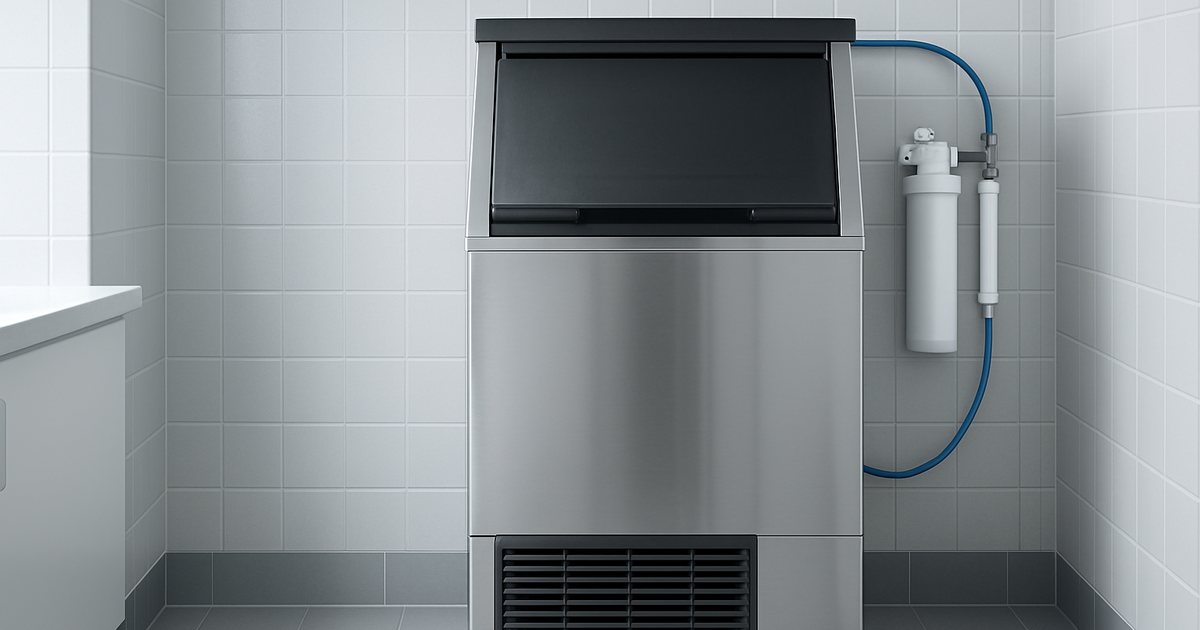
Short answer: No, a standard ice machine water filter does not remove Legionella. Handled badly, it can even make the problem worse. The carbon cartridge on the supply line removes the chlorine that was suppressing bacteria. It also traps the organic matter bacteria feed on. And it often sits in a machine warmed by its own compressor. CMS’s Legionella memo for US hospitals and nursing homes (QSO-17-30) names “water filters” and “ice machines” among the building components where Legionella can grow. In a 2024 hospital investigation, 10 of 22 ice machines tested positive once the facility widened its testing from 1% of its fleet to 8%. This guide covers what each cartridge type can and cannot claim, the replacement arithmetic that puts the oldest filters in the riskiest machines, and how to specify ice machine filtration for healthcare and hospitality buyers.
We manufacture ice machine cartridges in Ningbo: carbon block, sediment, polyphosphate scale-inhibitor, Everpure-compatible and inline UF. None of them is sold as a Legionella barrier. This article explains why, and what to ask any supplier, including us.
Why the Ice Machine Filter Is on the Regulator’s List
Most buyers think of the filter as the safety device. Legionella control plans see it differently.
Here is what happens to the water on its way into an ice machine:
- Municipal water arrives with a disinfectant residual, usually 0.2–4.0 mg/L free chlorine or chloramine. This residual is what keeps bacterial regrowth in check in the building’s pipes.
- The carbon block removes that residual. Removing it is the job: chlorine causes off-taste ice and attacks evaporator plating. But below the filter, the water has no active disinfectant left.
- The carbon traps organic carbon and bacteria from the incoming water. That makes the cartridge a surface with food on it.
- The machine warms its own supply line. The CDC gives Legionella’s growth range as 77–113°F (25–45°C) and notes it can grow at temperatures as low as 68°F (20°C). A filter head mounted beside a condenser, or a supply line routed through the machine’s warm compartment, can sit in that range for hours.
- Low-use machines stagnate. A machine on a quiet ward can hold the same water in the filter housing for days.
That is why the CMS memo QSO-17-30 (issued June 2, 2017, revised July 6, 2018) lists water filters next to water heaters, storage tanks and aerators as components where Legionella can grow. It also names ice machines as a device that can spread contaminated water. Hospitals, critical access hospitals and nursing homes that bill Medicare or Medicaid must have a water management program that considers ANSI/ASHRAE Standard 188 (current edition 188-2021) and the CDC’s Legionella toolkit. For ice machines, the CDC toolkit’s instruction is short: “Clean regularly and replace filters per manufacturer recommendations,” and consider routine Legionella testing where occupants are at high risk.
So the filter’s replacement schedule is now part of a compliance document. That changes what a buyer needs from the supplier.
The Evidence: Ice Machines Are a Documented Exposure Route
Here are the cases that shaped current practice:
| Case | What was found | Lesson for filter buyers |
|---|---|---|
| ICU case, Infection Control & Hospital Epidemiology, 1997 | A 66-year-old ventilated ICU patient developed Legionnaires’ disease (L. pneumophila serogroup 6). His only potable water intake was ice chips from the unit’s ice machine. | Aspirating ice counts as exposure, not only inhaling aerosols |
| UPMC, Pittsburgh, 2014 | Legionella found in ice machines after a patient who had eaten ice chips died. News reports said about 500 machines across 20 hospitals were sanitized. | A fleet-wide problem shows up one machine at a time |
| Multi-site study, 2018 (5 hospitals, 2 nursing homes) | Gram-negative bacteria in 100% of drain pan samples, 52% of ice/water chute samples and 72% of drain-pan grills (as summarized by Chem-Aqua) | Contamination builds up downstream of the filter |
| AdventHealth, presented at SHEA Spring 2025 | After a Legionella case on an oncology unit, the positive ice machine was in a low-traffic area. Testing grew from 4 of 270 machines (1%) to 22 (8%), and 10 of 22 (45.5%) were positive. Contaminated units were remediated and flushed for 24 hours. | Low use is the risk signal. Testing 1% of a fleet hides the problem |
The pattern that matters for filter buyers is the AdventHealth one. The contaminated machine was the one used least. Keep that in mind for the replacement math below.
Supplying hospitals, clinics or hotel groups? Send us your machine list and the risk tier of each location. We’ll return a cartridge plan with time limits, flush volumes and box wording that fits a water management program. Request a cartridge plan
Looking for a reliable water filter manufacturer?
Get free samples and a factory-direct quote. MOQ from 500 pcs.
Get a Free Quote →What Each Cartridge Type Can and Cannot Claim
This table is written from the manufacturer’s side, so it is what we would defend in an audit:
| Cartridge type | Typical rating | What it is tested for | Can it be claimed as a Legionella barrier? |
|---|---|---|---|
| PP sediment | 1–50 µm nominal | Particle reduction | No |
| Carbon block (CTO), e.g. our coconut-shell block, iodine ≥ 1,100 mg/g | 0.5–5 µm nominal | NSF/ANSI 42 chlorine, taste and odor. NSF/ANSI 53 cyst claims are for 3–5 µm oocysts | No. It removes the disinfectant residual |
| Carbon + polyphosphate (typical ice machine cartridge) | 0.5–5 µm nominal | Chlorine, taste and odor, plus scale inhibition | No |
| Silver-impregnated carbon | Same as carbon | EPA-registered label covers protecting the filter, not the water | No. See the next section |
| Inline UF (hollow fiber), e.g. our I-10/I-11 UF | 0.01–0.2 µm | Bacteria reduction in the maker’s own tests (ours: 99.99%, i.e. 4-log) | Only as a reduction stage. Not a sterilizing-grade claim without ASTM F838 data |
| Sterilizing-grade POU membrane | 0.2 µm, validated | ASTM F838: 10^7 B. diminuta per cm² with no passage | Yes, within its rated service time. This is the healthcare benchmark |
Two points in this table get lost in most supplier catalogs.
First, a micron number on a carbon block is not comparable to a membrane rating. A “0.5 micron” carbon block is a nominal particle-reduction figure. Legionella cells are roughly 0.3–0.9 µm wide and 1.5–5 µm long (Fields et al., Clinical Microbiology Reviews, 2002). Even a true 0.5 µm pore would not reliably stop the narrowest cells, and a nominal rating is not a pore size. The 0.2 µm membrane standard exists because small waterborne organisms passed through the older 0.45 µm “sterilizing” membranes. For more on how the numbers are defined, see our water filter micron rating guide.
Second, 99.99% is not sterile. A 4-log reduction on a challenge of 10 million cells lets about 1,000 through. ASTM F838 asks a different question: does anything get through at 10^7 cells per cm² of filter area? Our inline UF cartridges are a real bacteria-reduction stage, and they are useful behind a carbon block. We don’t sell them as a sterilizing-grade Legionella barrier, and your distributor catalog shouldn’t either.
The Silver Carbon Claim: What the EPA Label Actually Says
Silver-impregnated carbon is the most common place where marketing goes beyond the regulations.
In the US, silver carbon media is registered as a pesticide under FIFRA. Here is the approved label for one registered product, Calgon Carbon Type CE Bacteriostatic Water Filter Media, EPA Reg. No. 58295-2 (label dated 10/05/2020):
- Active ingredient: metallic silver 1.05% (from silver nitrate)
- Claim: “This product inhibits the growth of non-public health bacteria in the filter to prolong the life of the filter.”
- Scope: “Designed to remove objectionable tastes, odors, and color from municipally-treated tap water.” Cold water only.
The claim covers non-public health bacteria, in the filter, to prolong the filter’s life. It says nothing about Legionella and nothing about the water you drink. The EPA approval letter adds that claims on a website may not differ substantially from the registered label. Independent reviews of EPA-sponsored testing have found silver carbon made little lasting difference to bacterial counts in filter effluent, with lower counts mainly in the first month of use.
We use silver-impregnated carbon in some cartridges, for example the final stage in our Aquaphor-compatible K7. It is there to keep the cartridge itself from fouling during idle periods. That is the whole claim. If a supplier’s brochure says silver carbon “kills Legionella” or “prevents bacteria in ice,” expect a US customs broker, a hospital infection-control team or the EPA to reject it. The importer is the one exposed.
Related: for US imports of any filter that claims to remove microorganisms, physical filters making microbial claims are regulated as pesticidal devices. They are not registered individually, but they must be made in an EPA-registered establishment, and claims must not be false or misleading. Ask about this before you print “removes bacteria” on a box.
The Replacement Math: Gallon Ratings Put the Oldest Filter in the Riskiest Machine
This is the part no competitor article calculates.
Ice machine cartridges carry two limits: a gallon rating and a time limit (usually 6 months). Many operators only track gallons, because a head with a meter or a production log makes that easy. Gallons measure chlorine capacity. Biofilm growth depends on time and temperature.
Assume about 20 gallons of water per 100 lb of ice, a typical figure for modern air-cooled cubers including purge water. Your machine’s spec sheet will give its own number. With a 9,000-gallon carbon cartridge:
| Location | Rated capacity | Actual use | Water/day | Days to reach 9,000 gal | Gallon-only change interval |
|---|---|---|---|---|---|
| Busy restaurant bar | 500 lb/day | 80% → 400 lb | 80 gal | 113 | ~3.7 months |
| Hotel floor dispenser | 250 lb/day | 30% → 75 lb | 15 gal | 600 | ~20 months |
| Quiet hospital ward | 400 lb/day | 25% → 100 lb | 20 gal | 450 | ~15 months |
On a gallon-only schedule, the busiest, best-flushed machine gets a fresh cartridge every quarter. The quiet ward machine keeps the same carbon for over a year, and the ward is where the ice goes to vulnerable patients. That is the same low-traffic pattern that turned up in the AdventHealth investigation.
The time limit exists to correct this. Our recommendation to distributors writing plans for healthcare customers:
- Healthcare (patient-facing): change at 3–4 months or at the gallon rating, whichever comes first. Pair with a validated 0.2 µm POU membrane where the infection-control team requires one.
- Hospitality and food service: 6 months or gallon rating, whichever comes first. See our restaurant water filter replacement schedule for cartridge-by-cartridge intervals.
- Seasonal or idle machines: replace the cartridge and sanitize the machine before recommissioning. Don’t restart on a cartridge that sat wet through the off-season.
If you are sizing cartridges from scratch, our ice machine water filter sizing guide covers capacity by machine output.
Installation Details That Decide Whether the Filter Helps or Hurts
Most of the risk sits in the installation, not the cartridge. Here is what we put in our OEM installation cards:
- Mount the filter head on the cold supply line, away from the condenser exhaust and compressor compartment. A head mounted in the warm air path can sit at 77–95°F all day.
- Flush after every cartridge change. Run at least 2–3 gallons to drain, or the volume the head maker specifies, before connecting to the machine. This clears carbon fines and the stagnant water that sat in the head.
- Sanitize the head and the bowl O-ring seat when changing cartridges. The cartridge is new; the head it screws into is not.
- Write the install date on the cartridge label. Auditors reviewing a water management plan look for dated records, and a date on the cartridge is the simplest one.
- Store spare cartridges sealed, dry and cool, and use them in date order. A pre-wetted cartridge left in an open box is already growing a biofilm. See our cartridge shelf-life and storage guide.
- Keep the scale inhibitor. Removing the filter to “fix” a bacteria problem brings back scale, and scale on evaporators and bins also gives bacteria somewhere to attach. Our scale inhibitor comparison explains the options.
- If the site uses chloramine, specify catalytic carbon rated for it. Standard carbon exhausts on chloramine much faster than on chlorine. See chloramine removal with catalytic carbon.
Where Our Rules Stop Working
A few honest limits on the guidance above:
- The 20 gal per 100 lb figure varies. Water-cooled machines use far more water, and nugget/flake machines use less purge water. Recalculate using the machine’s spec sheet.
- Time limits are a policy, not a measured failure point. No study says biofilm becomes dangerous at day 121. The 3–4 month healthcare interval is a conservative choice that many facilities adopt, not a standard.
- Filters are one control among many. CDC’s toolkit and ASHRAE 188 treat ice machines as one point in a building-wide plan: supply temperature, disinfectant residual at the point of entry, cleaning of bins and chutes, and testing. A perfect filter program will not fix a contaminated bin or a dead-leg supply line.
- Outside the US, the rules differ. The UK’s HSG274, EU member-state rules and Australian state health guidance each set their own expectations. The physics of carbon removing residual disinfectant is the same everywhere; the paperwork is not.
How to Specify Ice Machine Filters for Healthcare and Hospitality Buyers
If you distribute into hospitals, nursing homes, hotels or airport concessions, here is the specification package that works:
| Specification item | What to put on the PO |
|---|---|
| Cartridge media | Coconut-shell carbon block + polyphosphate; catalytic carbon where chloramine is used |
| Claims on box/invoice | Chlorine taste and odor reduction, scale inhibition. No Legionella or “antibacterial” claims on carbon or silver carbon |
| Time limit | Printed on the label: “Replace every 6 months or at X gallons, whichever comes first,” with space for the install date |
| Healthcare add-on | Validated 0.2 µm POU membrane from a supplier with ASTM F838 data, or our UF stage labeled as “bacteria reduction” only |
| Test documents | NSF/ANSI 42 (and 53 where claimed) reports in the manufacturer’s name. See our NSF certification guide |
| Compatibility | Fits the site’s heads: Everpure, 3M/CUNO or inline quick-connect. See our Everpure-compatible cartridges and ice machine filter range |
| Commercials | MOQ 200–500 pcs per model, private label from 500 pcs, 15–25 days, FOB Ningbo |
A healthcare buyer reading your catalog should see that you know where the carbon cartridge’s job ends. Most suppliers in this category blur that line, so being clear about it sets you apart.
Related Guides
- Ice Machine Water Filter Sizing Guide
- Ice Machine Water Filter Compatibility Guide
- Restaurant Water Filter Replacement Schedule
- Water Filter Micron Rating Guide
- RO vs UF Water Purification Comparison
- Dental Office Water Filter Guide (DUWL & CDC Compliance)
- Inline UF Water Filter Cartridge (I-10 UF)
Request a Quote for This Product: send us your ice machine models, cartridge heads and the risk tier of each site. Within 12 hours we’ll reply with a cartridge plan: media, time limits, flush volumes and box wording that a hospital infection-control team will accept.
Frequently Asked Questions
- Does an ice machine water filter remove Legionella?
- A standard ice machine filter does not. Most ice machine cartridges are carbon block or carbon-plus-sediment cartridges rated between 0.5 and 5 microns nominal, certified (if at all) to NSF/ANSI 42 for chlorine taste and odor and sometimes NSF/ANSI 53 for cyst reduction. Neither standard includes a bacteria challenge. Legionella cells are roughly 0.3–0.9 µm wide, so a nominal 0.5 µm carbon block is not a validated barrier. The industry benchmark for a bacteria-retentive filter is a 0.2 µm membrane that has passed ASTM F838, which challenges the filter with 10^7 Brevundimonas diminuta cells per square centimeter of filter area. If you need a Legionella barrier at the ice machine, you need a membrane point-of-use filter with that test data, not a carbon cartridge.
- Can a carbon water filter make Legionella worse?
- It can raise the risk if it is managed badly. Carbon's job is to remove chlorine or chloramine, which is the same disinfectant residual that suppresses bacterial growth in the building's pipes. Downstream of the carbon, water has little or no residual left. Carbon also traps organic matter that bacteria feed on. A cartridge that sits in a warm cabinet next to the compressor, in a low-use machine, for a year because it has not yet hit its gallon rating, is a biofilm site. That is why the CMS memo QSO-17-30 lists water filters and ice machines among the building components where Legionella can grow. The fix is not removing the filter (scale and taste problems return). It is replacing on a time limit, flushing after every change, and keeping the filter off hot surfaces.
- Are silver-impregnated carbon filters antibacterial?
- Only in a narrow, legally defined sense. In the US, silver-impregnated carbon media is an EPA-registered pesticide product. The label for one registered media (EPA Reg. No. 58295-2, 1.05% metallic silver) states that it inhibits the growth of non-public health bacteria in the filter to prolong the life of the filter. That is a claim about protecting the filter itself, not about protecting the person drinking the water. A supplier who tells you a silver carbon cartridge 'prevents Legionella' or 'kills bacteria in your water' is making a public-health claim that the registered label does not support, and that claim can expose the importer, not only the factory.
- How often should ice machine filters be changed in a hospital or hotel?
- Change at the gallon rating or at a fixed time limit, whichever comes first, and set the time limit by risk. Most ice machine OEMs and filter makers use 6 months as the default time limit. For machines that serve immunocompromised patients, many facilities write a shorter interval (3–4 months) into their water management plan. Low-use machines matter most. At about 20 gallons of water per 100 lb of ice, a machine making 100 lb a day takes about 450 days to use up a 9,000-gallon cartridge. On a gallon-only schedule, the least-used machine keeps the oldest, most colonized filter. The time limit is what prevents that.
- What micron rating is needed to stop Legionella?
- The recognized reference is 0.2 µm, and only when it is backed by a bacterial retention test. ASTM F838 is the test method used to qualify sterilizing-grade membranes, and the 0.2 µm rating became standard because smaller waterborne organisms passed through the older 0.45 µm membranes. A micron number printed on a carbon block is a nominal rating. It usually describes particle reduction per NSF/ANSI 42, not bacterial retention, and it cannot be compared with a membrane rating. Ask for the test method behind any number.
- What should a hospital or hotel buyer ask a filter supplier about Legionella?
- Ask five things. First, which standard each claim is tested to (NSF/ANSI 42, 53, ASTM F838), and ask for the report, not a brochure. Second, the exact wording on the box and the invoice about bacteria. It should not claim protection from Legionella unless it is a validated membrane product. Third, the cartridge's recommended time limit, not only its gallon capacity. Fourth, the flushing volume after installation. Fifth, for US imports of any cartridge that claims to remove microorganisms, whether the product is made in an EPA-registered pesticide-producing establishment, because physical filters that make microbial claims are regulated as pesticidal devices.
- Do you supply ice machine filters and UF cartridges for healthcare distributors?
- Yes. We make carbon block (CTO), sediment and scale-inhibitor ice machine cartridges, Everpure-compatible cartridges, and inline UF cartridges rated 0.01–0.2 µm with 99.99% bacteria reduction in our own testing. We state plainly that 99.99% (4-log) reduction is not the same as a sterilizing-grade ASTM F838 validation. We do not label our cartridges as Legionella barriers. MOQ is 200–500 pcs per model depending on the cartridge type, private label from 500 pcs, and lead time is 15–25 days FOB Ningbo. Send us the machine models and the risk tier of each location, and we will return a cartridge plan with time limits and box wording written for your market.
Looking for OEM Water Filter Cartridges?
Get a factory-direct quote from Ningbo XZH — 15+ years OEM experience, 50+ export markets, MOQ from 500 pcs.
Get a Free Quote →Get Our Full Product Catalog
100+ SKUs with specs, MOQ, and factory-direct wholesale pricing — everything covered in this article and more.