
Blog ·
Nominal vs Absolute Micron Rating: What 5 µm Really Means
Nominal has no standard: 60% to 98% depending on who writes it. Beta ratios, NSF/ANSI 42 classes, and the PO wording that stops a PP cartridge spec being gamed.
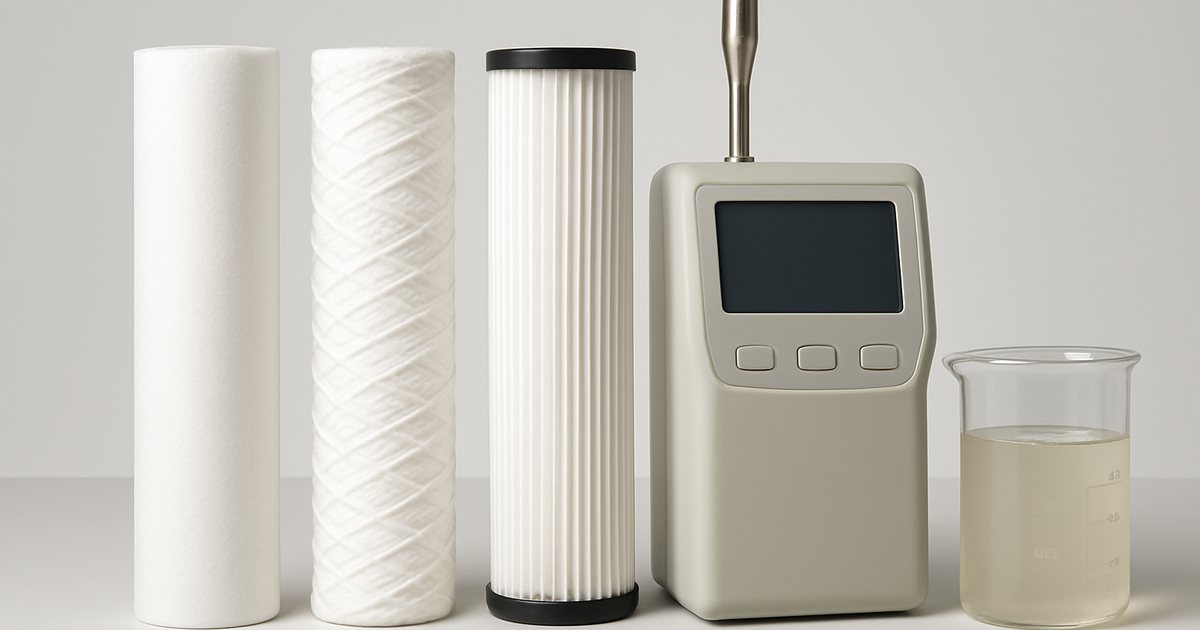
Short answer: A nominal micron rating is a claim that a filter removes some percentage of particles at the stated size, and there is no single standard for what that percentage is. Published definitions run from 60% to 98%. An absolute rating is usually taken to mean 99.9% (3-log, beta 1000), but even that varies: the ultrapure-water industry uses 99.99%, and some industrial suppliers call 98–99% “absolute.” So “5 micron” on a cartridge is not a specification. It becomes one only when the supplier states three more things: the efficiency at that size, the test method, and the flow rate. This guide explains what each rating system actually certifies (beta ratio, NSF/ANSI 42 particulate classes, NSF/ANSI 53 cyst reduction) and how to write a micron spec into a purchase order so a supplier cannot quietly substitute a looser cartridge.
We manufacture PP sediment, carbon block and UF cartridges in Ningbo, so we are the people who print that micron number on the label. This article is written from the factory side of it.
Key takeaways
- "Nominal" has no standard definition. The same printed "5 µm" can mean 60%, 85% or 95% removal depending on the manufacturer.
- Beta ratio is the only number that makes two suppliers comparable: beta 10 = 90%, beta 100 = 99%, beta 1000 = 99.9%.
- NSF/ANSI 42 particulate Classes I–VI are all nominal (≥85% reduction). Cyst reduction is a separate NSF/ANSI 53 test at 99.95%.
- ASTM F795, still quoted on many Chinese data sheets, was withdrawn in 2002. EN 1822 is an air-filter standard.
- Write efficiency, test dust, flow per 10-inch and clean-vs-loaded condition into the PO, or the micron number is unenforceable.
Why “5 Micron” on Its Own Is Not a Specification
A micron number describes a particle size. It does not describe how many of those particles the filter stops. That second number is the one that matters, and it is the one most labels leave out.
Here is how different bodies and markets have defined the two terms:
| Source | ”Nominal” means | ”Absolute” means |
|---|---|---|
| Common industry practice (WC&P survey, 2000) | 60%, 70%, 80% or more, depending on the maker | Not defined; third-party validation advised |
| Water Quality Association (as cited in WC&P) | 85% rejection at the stated size | 99.9% (3-log) rejection |
| Ultrapure water industry | — | 99.99% (4-log) reduction |
| Typical cartridge-maker usage | ”Usually understood as below 90%“ | Often 98–99.9%, defined by the maker |
| NSF/ANSI 42 particulate classes | ≥85% reduction in the class size range | Not used. All classes are nominal |
Two consequences follow for a buyer.
First, two “5 µm nominal” cartridges are not interchangeable. At 60% efficiency, 40 of every 100 particles at 5 µm get through. At 95%, five get through. That is an 8× difference behind an identical label.
Second, “absolute” without a number is no better. If a supplier calls a depth cartridge “5 µm absolute,” ask “at what efficiency, measured how?” If they cannot answer in one line, the word was chosen by the marketing department.


Beta Ratio: The Number That Makes Suppliers Comparable
The beta ratio removes the vocabulary problem. It is a count:
β(x) = particles ≥ x µm upstream ÷ particles ≥ x µm downstream
Efficiency follows directly: efficiency = (1 − 1/β) × 100%.
| Beta ratio at x µm | Removal efficiency | Particles passed per 1,000 | What suppliers tend to call it |
|---|---|---|---|
| β = 2 | 50% | 500 | Coarse “nominal” |
| β = 10 | 90% | 100 | Good nominal |
| β = 100 | 99% | 10 | ”Near-absolute” |
| β = 1,000 | 99.9% | 1 | Absolute (WQA / 3-log) |
| β = 5,000 | 99.98% | 0.2 | Absolute, critical service |
| β = 10,000 | 99.99% | 0.1 | Absolute, ultrapure (4-log) |
The jump from β10 to β1000 looks like a few decimal places. It is a 100× difference in particles passed. That is why the beta ratio should be on any spec where the downstream stage is expensive (an RO membrane, a coffee boiler, a dental unit) or where a health claim depends on it.
The multi-pass beta test was standardized for hydraulic oil (ISO 16889). Water cartridges are usually tested single-pass with a standard test dust, most often ISO 12103-1 A2 Fine or A4 Coarse. The method changes the absolute number, which is one more reason to write the method into the order.
Looking for a reliable water filter manufacturer?
Get free samples and a factory-direct quote. MOQ from 500 pcs.
Get a Free Quote →What NSF/ANSI 42 Particulate Classes Actually Certify
Many buyers read an NSF/ANSI 42 particulate listing as proof of an absolute rating. It is not. Every class is a nominal, ≥85% claim:
| NSF/ANSI 42 class | Particle size range | Required reduction | Absolute? |
|---|---|---|---|
| Class I | 0.5 to <1 µm | ≥85% | No |
| Class II | 1 to <5 µm | ≥85% | No |
| Class III | 5 to <15 µm | ≥85% | No |
| Class IV | 15 to <30 µm | ≥85% | No |
| Class V | 30 to <50 µm | ≥85% | No |
| Class VI | ≥50 µm | ≥85% | No |
| For comparison: NSF/ANSI 53 cyst reduction | 3 µm microspheres or live Cryptosporidium | ≥99.95% | Effectively yes, for that claim |
Two details from the test method matter in practice. Both are described by NSF’s Rick Andrew in Water Conditioning & Purification:
- Shedding is subtracted. Background particle counts from the flushing samples are subtracted from the effluent counts. A cartridge that sheds fibers can still pass Class I. If your end user cares about fines downstream (espresso machines, solenoid valves, RO membranes), ask for flush-water turbidity separately.
- The tests do not predict each other. A system can pass particulate Class I and fail cyst reduction, or pass cyst reduction and fail turbidity. They measure different characteristics. A Class I listing is not a cyst claim, and a micron number is never a cyst claim on its own.
For how these listings fit together across NSF/ANSI 42, 53, 58 and 401, see our NSF 42 vs 53 vs 401 comparison.
Need a sediment cartridge with a stated efficiency, not just a micron number?
Send us your micron size, target efficiency, flow per 10-inch length and downstream stage. We will tell you whether melt-blown, pleated or membrane media can meet it, and quote FOB Ningbo within 2 working hours.
Request a quote for this specWhy Depth Cartridges Are Hard to Make “Absolute”
Most sediment cartridges sold worldwide are depth filters: melt-blown or string-wound polypropylene. They trap particles throughout a thick wall, not at a single surface. That gives them high dirt-holding capacity and a low price. It also makes their efficiency move with operating conditions:
- Flow rate. Higher face velocity pushes particles deeper and through. A cartridge rated at 1 gpm per 10-inch length will pass more fine particles at 4 gpm. That is why the WC&P survey says a micron rating “must be accompanied with a flow rate.”
- Loading and unloading. As the cartridge loads, pressure drop rises. Pressure surges and water hammer can push trapped particles out the downstream side. The same survey notes that string-wound cartridges “sometimes deform and dump sediment” under high pressure or water hammer.
- Clean vs loaded efficiency. Some depth cartridges filter better as they load (the cake becomes part of the media). A rating measured on a part-loaded cartridge can flatter a new one.
| Media type | Filtration mechanism | Rating basis you can realistically get | Unloading risk | Typical 10” FOB (1,000 pcs) |
|---|---|---|---|---|
| String-wound PP | Depth, uniform density | Nominal; widest spread between makers | High (yarn shifts under surge) | ~10–20% below melt-blown |
| Melt-blown PP, gradient density | Depth, graded outer-to-inner | Nominal; β10–β100 achievable at stated flow | Moderate | $0.35–$0.55 (5 µm) |
| Pleated PP / polyester | Surface | Near-absolute to absolute at higher micron sizes | Low | Several times melt-blown |
| Carbon block (CTO) | Depth + adsorption | Nominal; cyst claim only via NSF/ANSI 53 test | Low (rigid) | Higher; media-dependent |
| UF hollow fiber membrane | Surface, pore-size controlled | Absolute-type, verified by integrity test | Very low | Highest of these |

The practical rule we give distributors: if you need an absolute claim, change the media type, not the label. A melt-blown cartridge can be made tighter. But a “1 µm absolute” melt-blown cartridge usually loads in a fraction of the time and has a pressure drop your customer will notice. For a deeper look at how melt-blown, string-wound and pleated PP compare in production, see our PP sediment filter cartridge guide.
Five Ways a Micron Rating Gets Gamed or Misread
These come up repeatedly when we review competitor data sheets that importers send us:
| Red flag on the data sheet | What it hides | What to ask for |
|---|---|---|
| Micron number with no efficiency | Could be 60% or 95% | Efficiency % or beta ratio at that size |
| No flow rate | Rating may have been measured at a trickle | Flow per 10-inch length (e.g. 2 gpm) |
| Cites ASTM F795 | Standard withdrawn in 2002 | The method actually run, with test dust |
| Cites EN 1822 | Air-filter (HEPA/ULPA) standard, not water | A liquid test method |
| ”Bubble point verified” on a melt-blown cartridge | Bubble point qualifies membranes, not depth media | Particle-count challenge data |
| ”Efficiency by weight” (gravimetric) | Big particles dominate mass; fines can pass | Particle-count efficiency at the rated size |
If a supplier’s quality section for a melt-blown or string-wound cartridge leans on bubble point, treat it as a sign they are copying a membrane template. Ask for the particle-count challenge data instead.

How to Write the Micron Spec Into Your Purchase Order
The fix is a few lines of text in the PO or the approved-sample sheet. Here is the wording we recommend to importers, filled in for a typical 5 µm RO pre-filter:
Sediment cartridge, 10” × 2.5”, melt-blown PP, 5 µm nominal. Particle-count removal efficiency ≥90% at ≥5 µm (β5 ≥ 10), single-pass, ISO 12103-1 A2 Fine test dust, at 2 gpm (7.6 L/min) per 10-inch length, measured on a clean cartridge. Initial pressure drop ≤ 2 psi (0.14 bar) at 2 gpm. Report flush volume to <1 NTU. Test report per production batch; golden sample retained by both parties.
Each line closes a loophole. The efficiency stops a looser cartridge being substituted. The test dust and flow make results reproducible. The pressure-drop cap stops a supplier meeting the efficiency by simply over-densifying the cartridge. That would pass the particle test but cut cartridge life in half. For how to enforce the line at incoming inspection, see our water filter cartridge QC and AQL inspection guide.
Where Nominal Is Enough, and Where It Isn’t
You do not need an absolute rating everywhere. Paying for one where nominal works just shortens cartridge life.
| Application | Nominal acceptable? | What to specify instead of “absolute” |
|---|---|---|
| RO pre-filter, municipal water | Yes | 5 µm, ≥90% at stated flow; add 1 µm if SDI > 3–5 |
| Carbon block protection | Yes | 5–20 µm nominal upstream, sized to sediment load |
| Whole-house / point-of-entry sediment | Yes | 20 µm then 5 µm staging; flow per length |
| Coffee and espresso machines | Mostly | 5 µm with low-shedding flush spec |
| Cyst (Giardia, Cryptosporidium) claim | No | NSF/ANSI 53 cyst reduction listing, not a micron number |
| Bacteria claim | No | 0.2 µm membrane with ASTM F838 bacterial retention data |
| Healthcare ice machines | No for health claims | See our ice machine filter and Legionella guide |
For the size-by-size breakdown of what each rating removes (1, 5, 10, 20, 50 µm) and the matching pressure-drop trade-off, see the water filter micron rating chart. If you are deciding between sediment, carbon and membrane stages in the first place, start with sediment vs carbon vs RO membrane.
What We Will and Won’t Put on Our Labels
Being specific about our own limits is the point of this article:
- We label melt-blown and string-wound PP as nominal. We do not print “absolute” on depth cartridges, even when a buyer asks. We can build a tighter cartridge and state its efficiency at your flow rate instead.
- We state the efficiency basis (particle count, clean cartridge, test dust and flow) when a buyer specifies one, and we hold a retained sample per batch.
- Our UF cartridges carry a pore-size rating backed by membrane integrity testing. We still do not call 99.99% bacteria reduction a sterilizing-grade claim, because that requires ASTM F838 validation.
- Cyst and health claims depend on the finished system’s NSF/ANSI 53 listing, not on any micron number we print.
Standard PP cartridges ship in 15–20 working days FOB Ningbo, with trial orders from a few hundred pieces and private label typically from 2,000 pieces per SKU. Browse our standard and commercial cartridges or our OEM manufacturing service.

Related Guides
- Water filter micron rating chart: 0.5 to 50 µm explained
- PP sediment filter cartridges: specifications and OEM sourcing
- NSF 42 vs 53 vs 401 certifications explained
- Water filter cartridge QC and AQL inspection
- Turning a water test report into a filter spec
- UF ultrafiltration membrane cartridge guide
Request a Quote for a Spec-Backed Sediment Cartridge
Send us the micron size, efficiency, flow rate and downstream equipment, plus your target market’s certification needs. Our sales team (Cici and Nancy) replies within 2 working hours with an FOB Ningbo quote, a sample plan and the test basis we can commit to in writing.
Request a Quote for This Product
Sources: J. Hunt, “A Survey of Filter Cartridges,” Water Conditioning & Purification, Jan 2000; R. Andrew, “Cyst Reduction, Turbidity Reduction, Nominal Particulate Reduction Class,” WC&P, Jan 2005; NSF/ANSI 42 and 53; ASTM F795-88 (withdrawn 2002); ISO 16889; ISO 12103-1.
Last Updated: 2026-10-12
Frequently Asked Questions
- What is the difference between a nominal and an absolute micron rating?
- A nominal rating says a filter removes some percentage of particles at the stated size, and that percentage is chosen by whoever writes the label. Published nominal definitions range from 60% to 98%. The Water Quality Association has used 85% for nominal and 99.9% (3-log) for absolute, and the ultrapure-water industry uses 99.99% (4-log) for absolute. An absolute rating is only meaningful if the supplier tells you the efficiency, the test method and the flow rate behind it. Without those three numbers, 'absolute' is a marketing word, not a specification.
- Is a 5 micron nominal filter the same as a 5 micron absolute filter?
- No. A 5 µm nominal melt-blown cartridge may let 10–15% of 5 µm particles through and still meet its label. A cartridge that is genuinely 5 µm absolute at 99.9% (beta 1000) removes about 999 of every 1,000 particles at that size. In practice, a 5 µm absolute depth cartridge often behaves more like a 1–2 µm nominal cartridge, so it clogs faster, has a higher pressure drop and costs more. Two cartridges with the same printed number can differ by a factor of 100 in how many 5 µm particles they pass.
- What is a beta ratio in water filtration?
- The beta ratio is the number of particles at or above a given size upstream of the filter divided by the number at or above that size downstream. Beta 2 equals 50% efficiency, beta 10 equals 90%, beta 100 equals 99%, beta 1000 equals 99.9% and beta 5000 equals 99.98%. Its value is that it turns 'nominal' and 'absolute' into one comparable number. Ask for a beta ratio at your target micron size, at your flow rate, and at both the clean and the loaded condition of the cartridge.
- Does NSF/ANSI 42 certify a filter as absolute?
- No. NSF/ANSI 42 particulate reduction classes are nominal claims. A cartridge earns a class (Class I is 0.5 to under 1 µm, up to Class VI at 50 µm and above) by reducing particles in that size range by at least 85%. The test subtracts the particles the filter sheds during flushing, so a cartridge that sheds fibers can still pass. A Class I listing is also not a cyst claim. Cyst reduction is a separate NSF/ANSI 53 test that requires 99.95% removal of 3 µm microspheres or live Cryptosporidium oocysts, and passing one test does not predict the other.
- Which micron rating should I specify for an RO pre-filter?
- For most municipal-water RO systems, a 5 µm nominal melt-blown PP cartridge followed by a carbon stage is the industry default, and nominal is acceptable there because the job is protecting the carbon block and membrane from silt, not making a health claim. Where the feed has high silt density (SDI above 3–5) or the membrane is expensive commercial or industrial, add a 1 µm stage or specify the 5 µm stage with a stated efficiency of at least 90% at 5 µm. Specify the flow rate per 10-inch length too, because the same cartridge filters less efficiently at 4 gpm than at 1 gpm.
- What should a filter data sheet include for the micron rating?
- Six items: the micron size; the efficiency percentage or beta ratio at that size; whether the figure counts particles or weighs them; the test method and test dust (for example ISO 12103-1 A2 Fine); the flow rate per 10-inch length the test was run at; and whether the figure was measured on a clean cartridge or near its terminal pressure drop. If a data sheet cites ASTM F795, ask what method they actually ran, because that standard was withdrawn in 2002. If it cites EN 1822, that is an air-filter (HEPA) standard and does not apply to water cartridges.
- What is your MOQ and lead time for PP sediment cartridges with a stated efficiency?
- We make melt-blown, string-wound and pleated PP cartridges in 1, 5, 10, 20 and 50 µm in 5, 10 and 20 inch lengths, standard and jumbo diameters. Trial orders start from a few hundred pieces per model. Private label with custom packaging typically starts at 2,000 pieces per SKU. Standard cartridges ship in 15–20 working days FOB Ningbo. A plain 10 inch 5 µm melt-blown cartridge typically lands at $0.35–$0.55 FOB at 1,000 pieces. Tell us the efficiency, flow rate and test basis you need, and we will tell you plainly whether a depth cartridge can meet it or whether you need pleated or membrane media.
Looking for OEM Water Filter Cartridges?
Get a factory-direct quote from Ningbo XZH — 15+ years OEM experience, 50+ export markets, MOQ from 500 pcs.
Get a Free Quote →Get Our Full Product Catalog
100+ SKUs with specs, MOQ, and factory-direct wholesale pricing — everything covered in this article and more.