
Blog ·
Water Test to Filter Spec: Hardness, Chlorine & LSI | XZH
Turn a water test into a cartridge spec: gpg conversion, NSF 42 rates chlorine at 2.0 mg/L, LSI at 20-100 C, derating math. Send your report, free spec.
Short answer: A commercial water filter cannot be specified from the equipment model alone. Six numbers from a water test decide it: total hardness, free and total chlorine, TDS, total alkalinity, pH, and the service temperature. Hardness and chlorine set how long the cartridge actually lasts, alkalinity and pH decide whether the water scales or corrodes, and temperature is the reason a water profile that looks harmless in a cold line destroys an espresso boiler. Every rated capacity on a cartridge label — ours included — is measured at a fixed test condition, so the first job is to derate that number to your water.
We manufacture commercial filter cartridges in Ningbo for importers, foodservice dealers and private-label brands. This guide is the procedure our engineering team runs on every water report a customer sends, written so your team can run it before you ask us for a quote.
The Six Numbers That Decide a Cartridge Spec
Most sourcing enquiries arrive as “we need a filter for a Hoshizaki ice machine” or “quote me an Everpure H-300 equivalent”. That fixes the fitting and the flow rate. It does not fix the media volume, the carbon grade, or the replacement interval printed on your box — those come from the water.
| Parameter | Typical unit | Cheap test method | What it decides |
|---|---|---|---|
| Total hardness | mg/L as CaCO3, or gpg | Titration kit or strip, $10-30 | Scale risk; life of any scale-control or softening cartridge |
| Calcium hardness | mg/L as CaCO3 | Lab panel | The calcium term in the LSI calculation |
| Free chlorine | mg/L as Cl2 | DPD Free tablet/strip | Carbon block life; taste and odour performance |
| Total chlorine | mg/L as Cl2 | DPD Total tablet/strip | Total minus free = chloramine; decides standard vs catalytic carbon |
| TDS | mg/L (or µS/cm) | TDS meter, $15 | Whether carbon is enough or you need RO or UF |
| Total alkalinity | mg/L as CaCO3 | Titration kit | Buffering; the LSI alkalinity term; taste in coffee |
| pH | — | Meter or strip | LSI; corrosion risk on copper and stainless |
| Service temperature | °C at the equipment | Equipment datasheet | The single biggest swing factor in scale formation |
The two that buyers most often skip are total chlorine and alkalinity, and both of them change the bill of materials. Skipping total chlorine is how a coconut-shell carbon block ends up in a chloraminated city and gets returned for “bad taste”.
Hardness: “10,000 Gallons” Is Not a Capacity Until You Say at What Hardness
Hardness is reported in at least four units depending on who wrote the report, and half the specification errors we see start as a unit mix-up. One grain per gallon equals 17.1 mg/L as CaCO3.
| Hardness | mg/L as CaCO3 | Grains per gallon | USGS classification |
|---|---|---|---|
| Soft | 0-60 | 0-3.5 | Soft |
| Moderate | 61-120 | 3.6-7.0 | Moderately hard |
| Hard | 121-180 | 7.1-10.5 | Hard |
| Very hard | over 180 | over 10.5 | Very hard |
Classification per the U.S. Geological Survey Water Science School. Conversion: 1 gpg = 17.1 mg/L as CaCO3.
Now apply it. A cartridge label that says “10,000 gallons” is only meaningful next to the condition it was measured at. For an ion-exchange cartridge the arithmetic is exact, because the resin holds a fixed number of hardness grains:
| Water hardness | mg/L as CaCO3 | Gallons from a 10,000-grain cartridge |
|---|---|---|
| 3 gpg | 51 | 3,333 |
| 5 gpg | 86 | 2,000 |
| 7 gpg | 120 | 1,429 |
| 10 gpg | 171 | 1,000 |
| 15 gpg | 256 | 667 |
| 20 gpg | 342 | 500 |
| 25 gpg | 428 | 400 |
A distributor selling the same SKU into Dallas and into Seattle is selling a cartridge with a five-fold difference in service life. If the replacement interval on the carton is the same in both markets, one of those markets is getting warranty claims.
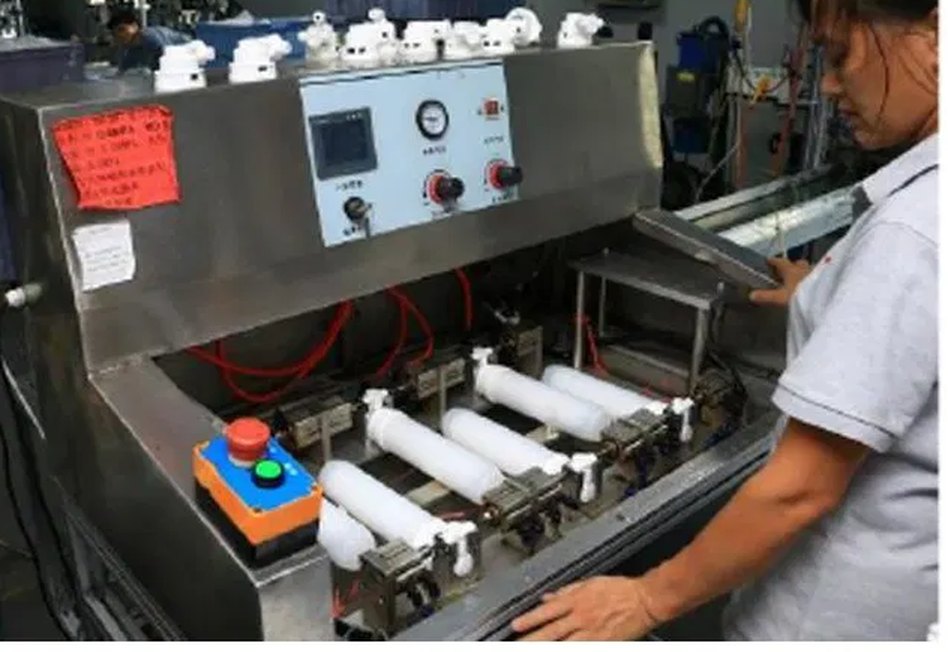
Looking for a reliable water filter manufacturer?
Get free samples and a factory-direct quote. MOQ from 500 pcs.
Get a Free Quote →Chlorine vs Chloramine: The Test Almost Every Buyer Skips
Free chlorine and chloramine are both measured “as Cl2” and both show up on a DPD test, but they need different carbon. The test is simple: measure free chlorine and total chlorine. The difference is combined chlorine — chloramine.
| Result | Reading | What it means | Cartridge consequence |
|---|---|---|---|
| Free ≈ Total | e.g. free 0.9, total 1.0 | Free-chlorine supply | Standard carbon block is fine |
| Total much higher than free | e.g. free 0.2, total 2.4 | Chloraminated supply | Needs catalytic carbon, longer contact time, lower rated flow |
| Free above 2.0 mg/L | e.g. 3.5 | High residual, common at plant-adjacent sites | Derate carbon life; consider larger carbon volume |
| Free near 0, total near 0 | — | Well water or long dead-leg | Chlorine is not the design driver; sediment and hardness are |
Two numbers anchor this section, and they are worth writing on the spec sheet:
- NSF/ANSI 42 chlorine reduction is tested at an influent challenge of 2.0 mg/L ± 10%, with a minimum required reduction of 50%. That is the condition behind essentially every “rated capacity” on a taste-and-odour cartridge. (NSF/ANSI 42 particulate reduction is a different claim with its own classes — Class I is challenged with a minimum of 10,000 particles/mL and requires at least 85% reduction.)
- The US EPA maximum residual disinfectant level for chlorine and for chloramines is 4.0 mg/L as Cl2, under 40 CFR 141.65. A utility is allowed to run twice the NSF test condition and still be fully compliant.
So a cartridge tested at 2.0 mg/L, installed on a legal 4.0 mg/L supply, is being asked to absorb twice the chlorine per gallon. Nothing is defective. The label just described a different water than yours.
Sourcing a compatible line and not sure which carbon grade your market needs? Send us the DPD free and total numbers for two or three cities in your territory. We will tell you whether one SKU covers the territory or whether you need a catalytic version for the chloraminated cities — before you commit to tooling or artwork. Talk to our engineering team.
Capacity Derating: The Math We Run Before We Quote a Rated Life
This is the part that separates a factory quote from a catalogue number. Different media are limited by different things, so they derate differently. Treating every cartridge as “gallons” is the most common error in the trade.
| Cartridge type | What actually limits life | Derating rule | Confidence |
|---|---|---|---|
| Carbon block, taste & odour | Chlorine mass absorbed | Life ≈ rated × (2.0 ÷ actual free Cl in mg/L) | First-order estimate — good for planning, conservative at high residuals |
| Catalytic carbon, chloramine | Contact time (EBCT) | Rated flow must be reduced, not just the gallons | Design change, not a derate |
| Ion exchange / softening cartridge | Hardness grains held | Gallons = grain capacity ÷ gpg | Exact arithmetic |
| Polyphosphate scale feed | Media dissolution — dose per volume | Roughly volume-limited; hardness decides whether it works at all | Reliable; see scale-control options |
| PP sediment | Pressure drop rise from solids load | Turbidity-driven; gallons ratings are nearly meaningless | Use ΔP, not a calendar |
| RO membrane | Fouling and scaling in the concentrate | Sized on concentrate chemistry, not feed | See the recovery section below |
Worked example, carbon block rated 6,000 gallons at the NSF challenge condition:
| Actual free chlorine | Planning life | vs label |
|---|---|---|
| 0.5 mg/L | ~24,000 gal | 4× |
| 1.0 mg/L | ~12,000 gal | 2× |
| 2.0 mg/L (test condition) | 6,000 gal | 1× |
| 3.0 mg/L | ~4,000 gal | 0.67× |
| 4.0 mg/L (EPA MRDL) | ~3,000 gal | 0.5× |
Be honest about what this model is. Carbon dechlorination is a surface-catalysed reaction, so capacity is closer to constant in mass of chlorine than in volume of water — which is why the inverse rule works as a planning estimate. At the high end it is optimistic, because contact time starts to limit the reaction before the carbon is exhausted. We publish it as a derating floor for interval setting, not as a performance guarantee, and we say so on the datasheet.
LSI: Why the Same Water Is Harmless Cold and Destroys an Espresso Boiler
The Langelier Saturation Index is the difference between measured pH and the saturation pH of calcium carbonate:
LSI = pH − pHs, where pHs = (9.3 + A + B) − (C + D), with A = (log₁₀[TDS] − 1) ÷ 10, B = 34.55 − 13.12 × log₁₀(°C + 273.15), C = log₁₀[Ca hardness as CaCO3] − 0.4, D = log₁₀[alkalinity as CaCO3].
Positive LSI means the water tends to deposit calcium carbonate. Negative means it tends to dissolve it and can be aggressive to metal. The term that matters for foodservice is B, the temperature term — it falls from 2.18 at 20 °C to 0.81 at 100 °C, which pushes LSI up by about 1.37 units for the same water simply by heating it.
Three real-world profiles, computed with the formula above:
| Water profile | 20 °C (cold line) | 60 °C (dishwasher) | 90 °C (espresso boiler) | 100 °C (steam) |
|---|---|---|---|---|
| A — typical municipal (pH 7.6, TDS 250, Ca 180, Alk 140) | −0.02 balanced | +0.71 scaling | +1.20 heavy scaling | +1.35 heavy scaling |
| B — soft coastal (pH 7.2, TDS 90, Ca 45, Alk 35) | −1.58 aggressive | −0.85 aggressive | −0.36 mildly aggressive | −0.21 near balance |
| C — hard Gulf / Middle East (pH 7.9, TDS 620, Ca 340, Alk 260) | +0.79 scaling | +1.51 severe | +2.01 severe | +2.16 severe |
Ca and Alk in mg/L as CaCO3. Computed from the standard LSI relationship; values rounded to two decimals.
Read Water A again. It is the water that passes every consumer “is my water hard?” test as merely average — and it is strongly scale-forming the moment it enters a 90 °C group head. This is why a filter that keeps a cold drinking tap perfect gets blamed when the espresso machine scales up in eight months: the cartridge was specified against the cold-water profile.
Two limits of LSI we tell customers about, because most blogs do not:
- LSI is a tendency, not a rate. An LSI of +2.0 does not mean twice the scale of +1.0. Use it to rank risk and to decide the treatment tier, then set the replacement interval from capacity math.
- At boiler temperatures the real situation is worse than the index. Heating drives off dissolved CO2, which raises pH beyond the value you measured cold, and calcium carbonate’s solubility falls with temperature. LSI computed from a cold-water sample is therefore the optimistic case for any steam or boiler position — the combi oven and steamer positions are always the first to fail in a kitchen for exactly this reason.
RO Systems Are Sized on the Concentrate, Not the Feed
If the answer is a membrane, the number that matters is not the feed water chemistry — it is the chemistry of what is left behind on the membrane surface. At recovery r, the concentration factor is 1 ÷ (1 − r).
| Recovery | Concentration factor | Concentrate Ca (mg/L) | Concentrate alkalinity | Concentrate LSI at 25 °C |
|---|---|---|---|---|
| Feed (no recovery) | 1.0× | 180 | 140 | +0.08 |
| 50% | 2.0× | 360 | 280 | +0.65 |
| 75% | 4.0× | 720 | 560 | +1.22 |
| 80% | 5.0× | 900 | 700 | +1.40 |
Water A feed profile; pH held constant, which is the conservative assumption.
A system running 75% recovery on ordinary municipal water is scaling its membrane at a concentrate LSI that most operators would associate with Middle East groundwater. That is why recovery, softening pre-treatment and flush frequency are specification decisions, not installer preferences — and why the recovery rate belongs on the datasheet of any tankless RO system you put your brand on.
Municipal Report vs Real Lab Test: What the Annual Report Hides
Customers frequently send us a utility’s annual report instead of a test. It is useful — free, and it tells you the disinfectant chemistry — but it has three structural blind spots.
| What you get from a CCR | What it hides |
|---|---|
| Regulated contaminants, detected levels | Hardness is not a regulated contaminant, so many CCRs omit it entirely (US CCR content is set by 40 CFR 141.153) |
| Annual average or range | Seasonal swings; a summer high can be double a winter low |
| System-wide figures | Chlorine residual at the end of a long distribution leg can be a fraction of the plant value |
| Treatment plant chemistry | Anything the building’s own plumbing adds — rust, copper, sediment after a main repair |
Practical rule: use the CCR to establish chlorine vs chloramine and the general mineral picture, then spend $30 on a point-of-use panel for hardness, free/total chlorine and TDS at the actual installation. For a multi-site chain, test three sites at the extremes of the distribution network rather than all of them.
From Water Profile to Cartridge Build
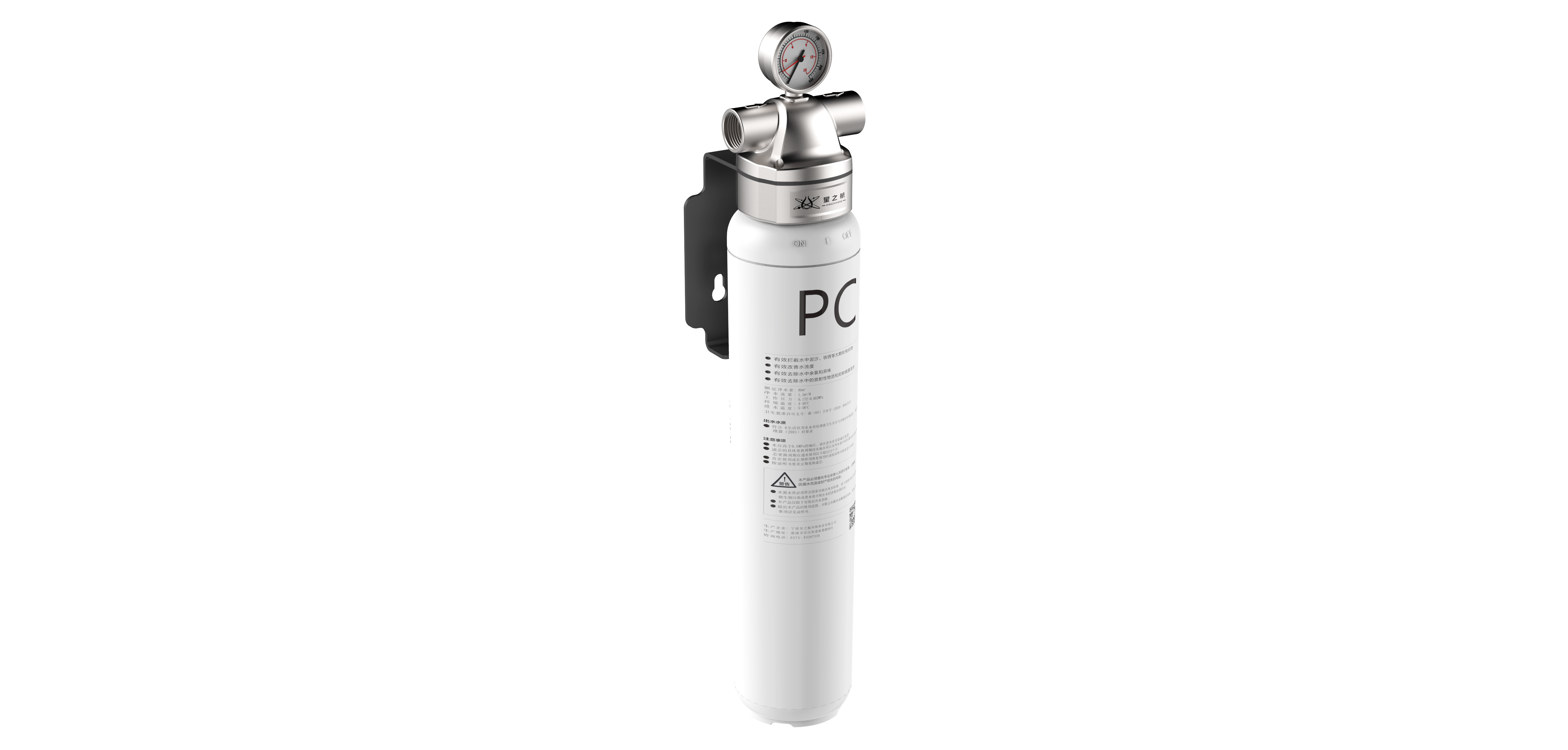
This is the matrix our engineers work from. It answers “what goes in the cartridge”, which is a different question from “which scale technology” — for that decision, see the scale control comparison.
| Measured profile | Sediment stage | Carbon stage | Scale stage | Membrane |
|---|---|---|---|---|
| Hardness <7 gpg, free Cl ≤2, TDS <250 | 5 µm PP | Standard carbon block | Not required | No |
| Hardness <7 gpg, chloramine present | 5 µm PP | Catalytic carbon, derate flow | Not required | No |
| Hardness 7-15 gpg, any steam equipment | 5 µm PP | Carbon block | Polyphosphate feed, fixed 6-month interval | No |
| Hardness 15-25 gpg | 1-5 µm PP | Carbon block | Ion exchange or softener ahead of boilers | Consider for espresso |
| Hardness >25 gpg or TDS >500 | 1-5 µm PP | Carbon block as pre-treatment | — | RO, blended back for coffee |
| Visible sediment, rust, old mains | 20 µm + 5 µm staged | Carbon block | Per hardness | Per TDS |
| Ice production, any hardness | 5 µm PP | Carbon block | Scale feed sized to ice machine flow | Only for clear-ice programs |
For coffee specifically there is a published target to aim at rather than a guess. The SCAA standard Water for Brewing Specialty Coffee (rev. 21 Nov 2009) specifies total chlorine 0 mg/L, TDS 150 mg/L (acceptable 75-250), calcium hardness 4 grains / 68 mg/L (acceptable 1-5 grains, 17-85 mg/L), total alkalinity at or near 40 mg/L, pH 7.0 (6.5-7.5) and sodium at or near 10 mg/L. Note what that means for RO: strip a hard water to near-zero TDS and you are below the standard, which is why permeate for espresso is blended back rather than used neat. The coffee machine filter line is built around hitting that window, not around maximum removal.
What This Means for Your Warranty Claims
From inside a cartridge factory, the pattern in warranty correspondence is remarkably consistent. Roughly speaking, the complaints that reach us divide into three kinds:
- “The filter died early.” Almost always a rating-condition mismatch — hard water, high chlorine residual, or a sediment load that raised ΔP long before the carbon was exhausted. No defect exists, but the buyer printed the test-condition interval on the carton and inherited the argument.
- “The water tastes wrong.” Usually a chloraminated supply with standard carbon, or an RO output used neat where the SCAA window called for blending.
- “The equipment scaled anyway.” Usually a scale feed past its interval — polyphosphate depletes silently with no visible symptom — or a cold-water spec applied to a boiler position.
All three are prevented at the specification stage by numbers the buyer already could have had for $30. If you are building a private-label programme, the single highest-value thing you can do is print an interval derated for your market rather than copying the branded original, and state the rating condition next to the capacity on your own datasheet. It costs nothing and removes the argument. The same discipline applies whether you are sourcing our compatible line or any other factory’s.
What to Send Us for a Free Spec
Specification work is free and does not require an order. Send:
- Water test: hardness, free and total chlorine, TDS, alkalinity, pH (a lab panel or clear photos of test strips both work).
- Equipment list and positions: ice machine, espresso, combi oven, dishwasher, fountain — with model numbers where you have them.
- Peak flow rate at each position, or the equipment datasheets.
- Target market and interval you want to print on the carton.
We return a cartridge build per position, a derated interval for that water, and an FOB quotation. Standard terms: MOQ 500 pcs per SKU, 15-20 days after sample approval and deposit, FOB Ningbo, T/T 30% deposit and 70% before shipment. Full sourcing process in our China cartridge sourcing guide, and certification questions are covered in the NSF, FDA and SGS guide.
Frequently Asked Questions
What water test results does a filter manufacturer actually need?
Six numbers cover almost every commercial job: total hardness, calcium hardness where available, free and total chlorine, TDS, total alkalinity and pH — plus the service temperature at the equipment. A $30 lab panel gives you all of them. Send those with the equipment list and peak flow and we can spec and quote without a site visit.
How do I convert grains per gallon to mg/L of hardness?
One grain per gallon equals 17.1 mg/L as CaCO3. So 7 gpg ≈ 120 mg/L, 10.5 gpg ≈ 180 mg/L, 20 gpg ≈ 342 mg/L. US datasheets usually use grains, Chinese and European lab reports usually use mg/L — convert both to one unit before comparing two cartridge ratings.
Why does my filter cartridge die long before its rated gallons?
Because the rating was measured on test water. NSF/ANSI 42 chlorine reduction is challenged at 2.0 mg/L ± 10%; the EPA maximum residual disinfectant level is 4.0 mg/L, so a legal supply can be twice the test condition and roughly halve the throughput. Ion-exchange cartridges are stricter still: gallons = grain capacity ÷ gpg, exactly.
Is a municipal water quality report enough to spec a filter?
It is a starting point. Hardness is not a regulated contaminant, so many annual reports omit the number that most controls cartridge life, and the values are system-wide averages. Use the report to identify chlorine vs chloramine, then test at the actual site for hardness, chlorine and TDS.
What is the Langelier Saturation Index and how do I use it?
LSI is measured pH minus calcium carbonate saturation pH: positive scales, negative is aggressive. Its value here is the temperature term. A typical municipal water (pH 7.6, TDS 250, Ca 180, alkalinity 140) computes to about −0.02 at 20 °C and +1.20 at 90 °C — balanced cold, strongly scaling in an espresso boiler. Use it to rank risk and pick a treatment tier, not to predict a scaling rate.
Do I need a water test if I am only buying compatible replacement cartridges?
You need it if the replacement interval on your carton is going to be true. A drop-in compatible inherits the branded cartridge’s rating conditions, so in a hard or highly chlorinated market you should print a derated interval rather than copying the original’s number. See our materials guide for what changes inside the cartridge.
What is your MOQ and lead time once the spec is settled?
MOQ 500 pcs per SKU, 15-20 days after sample approval and deposit, FOB Ningbo on T/T 30% deposit and 70% before shipment. Specification work is free. A new mould for a non-standard housing or fitting adds tooling cost and time, so confirm the interface before artwork.
Related Guides
- Water Filter Cartridge Materials Explained: PP vs Carbon Block vs RO vs UF
- Scale Control Compared: Polyphosphate vs Softeners vs RO
- Chloramine Removal: Catalytic vs Standard Carbon
- Ice Machine Water Filter Sizing: Flow Rate and Capacity
- Commercial Dishwasher and Glasswasher Water Filtration
- Coffee Machine Water Filter Manufacturers: OEM Sourcing Guide
- Water Filter Replacement Schedule for Restaurants
Send us your water report. We will return a cartridge build for every position, an interval derated for that water, and a factory-direct FOB quotation — no order required. Request a spec and quotation, or see what we build for OEM and private-label programmes.
Sources: U.S. Geological Survey, Hardness of Water (hardness classification); 40 CFR 141.65 (maximum residual disinfectant levels); 40 CFR 141.153 (Consumer Confidence Report content); NSF/ANSI 42 certified performance data (chlorine influent challenge 2.0 mg/L ± 10%, ≥50% reduction; Particulate Class I ≥85% at min. 10,000 particles/mL); SCAA Standard, Water for Brewing Specialty Coffee, rev. 21 Nov 2009.
Frequently Asked Questions
- What water test results does a filter manufacturer actually need?
- Six numbers cover almost every commercial job: total hardness (as mg/L CaCO3 or grains per gallon), calcium hardness if you have it separately, free and total chlorine, total dissolved solids, total alkalinity, and pH — plus the service water temperature at the equipment. Hardness and chlorine set the cartridge life, alkalinity and pH decide whether the water scales or corrodes, TDS decides whether carbon filtration is enough or you need a membrane, and temperature is what turns a harmless cold-water profile into a scaling one inside a boiler. A $30 lab panel gives you all six. Send those numbers with the equipment list and flow rate and we can spec and quote without a site visit.
- How do I convert grains per gallon to mg/L of hardness?
- One grain per gallon equals 17.1 mg/L (ppm) of hardness as calcium carbonate. So 7 gpg is about 120 mg/L, 10.5 gpg is about 180 mg/L, and 20 gpg is about 342 mg/L. US equipment datasheets and softener ratings usually use grains; European, Chinese and Middle East lab reports usually use mg/L as CaCO3, and French or German degrees appear on some European reports. Always convert to one unit before you compare two cartridge ratings, because a capacity quoted at 10 gpg and one quoted at 170 mg/L are the same condition written two ways.
- Why does my filter cartridge die long before its rated gallons?
- Because the rating was measured on test water, not yours. NSF/ANSI 42 chlorine reduction is tested at an influent challenge of 2.0 mg/L plus or minus 10 percent. If your supply runs 4.0 mg/L — the EPA maximum residual disinfectant level under 40 CFR 141.65 — the carbon has roughly twice the chlorine to absorb per gallon, so a first-order planning estimate halves the throughput. The same happens with scale: an ion-exchange cartridge holds a fixed number of grains, so at 20 gpg it delivers half the gallons it does at 10 gpg. Nothing failed; the rating condition simply was not your condition.
- Is a municipal water quality report enough to spec a filter?
- It is a starting point, not a spec. A US Consumer Confidence Report under 40 CFR 141.153 has to list detected regulated contaminants, and hardness is not a regulated contaminant — so many CCRs omit the single number that matters most for cartridge life. CCR values are also annual averages or ranges across an entire distribution system, and chlorine residual at the far end of a network can be very different from the plant. Use the CCR to learn whether the utility uses chlorine or chloramine, then confirm hardness, chlorine and TDS with a point-of-use test at the actual site.
- What is the Langelier Saturation Index and how do I use it for foodservice equipment?
- LSI is the difference between measured pH and the pH at which calcium carbonate is saturated: positive means the water tends to deposit scale, negative means it tends to be aggressive. The useful part for foodservice is the temperature term. Take a typical municipal supply at pH 7.6, 250 mg/L TDS, 180 mg/L calcium hardness and 140 mg/L alkalinity: LSI is about -0.02 at 20 C and about +1.20 at 90 C. The same water is balanced in the cold line and strongly scale-forming in an espresso boiler. Treat LSI as a direction and a ranking tool, not a scaling rate — at boiler temperatures CO2 loss pushes real pH and real scaling beyond what the index alone predicts.
- Do I need a water test if I am just buying compatible replacement cartridges?
- You need it if you want the replacement interval on your box to be true. A drop-in replacement for an Everpure or 3M cartridge has the same fitting and the same rated capacity, so it inherits the same rating conditions. If you are private-labelling for a market with hard water or a high chlorine residual, print a shorter interval or a gallons figure derated for that market instead of copying the brand's number. That one decision prevents most of the warranty arguments distributors have with end users.
- What is your MOQ and lead time once the spec is settled?
- Our MOQ is 500 pcs per SKU for standard cartridges and housings, with 15-20 days lead time after sample approval and deposit, FOB Ningbo on T/T 30 percent deposit and 70 percent before shipment. Specification work — reading your water report, sizing carbon volume and flow rate, and recommending the cartridge build — is free and does not require an order. Samples ship with freight paid by the buyer. A new mould for a non-standard housing or end fitting adds tooling cost and time, so confirm the interface before artwork.
Looking for OEM Water Filter Cartridges?
Get a factory-direct quote from Ningbo XZH — 15+ years OEM experience, 50+ export markets, MOQ from 500 pcs.
Get a Free Quote →Get Our Full Product Catalog
100+ SKUs with specs, MOQ, and factory-direct wholesale pricing — everything covered in this article and more.