Blog ·
Which Well Water Filter Cartridges Should Distributors Stock?
Stocking a water filter system for well water? Which sediment, iron and carbon cartridges to carry, in what micron and size, and what each stage can't fix.
Last updated: 2026-11-18
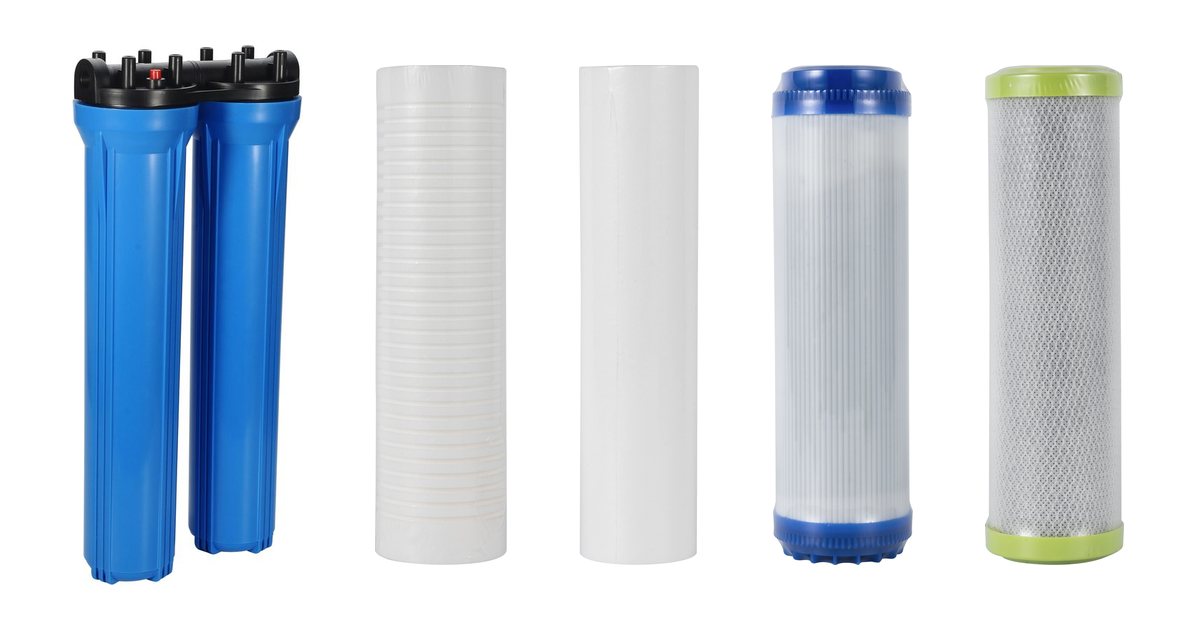
Short answer: a water filter system for well water is usually three or four cartridge stages in 20” × 4.5” Big Blue housings — a 20–50 µm coarse sediment stage, a 5 µm melt-blown PP stage, an iron-removal stage when the water test shows iron, and a GAC or CTO carbon stage for taste and odor. For a distributor, that means the core stock is sediment in two micron grades, carbon in two formats, and Big Blue housings with the right thread. What cartridges cannot do — kill bacteria, soften hard water, remove nitrate, or handle heavy iron — should be sold as separate equipment, not as a bigger filter.
This guide is for distributors, plumbing wholesalers, water-treatment dealers and private-label brands deciding which well water cartridges to carry. If you are a homeowner choosing a complete system, a local water-treatment dealer with your lab test in hand is the right next step.
Key takeaways
- Most well water returns come from sediment overload: one fine cartridge on a sandy well blinds in weeks. Stock 20–50 µm and 5 µm grades and sell them as a pair.
- The EPA secondary standards are 0.3 mg/L for iron and 0.05 mg/L for manganese; above those, water stains fixtures and an iron stage is needed.
- Cartridge iron removal only works at light loads (roughly 1–3 mg/L); heavier iron needs an oxidation/backwash tank, with cartridges as polishing stages.
- Well pumps typically deliver 5–10 GPM, so 20” Big Blue is the default size for whole-house well systems; 10” slim cartridges belong on drinking-water lines only.
- At our Ningbo factory, standard 10”/20” PP, CTO and GAC cartridges start at 1,000 pcs per model; custom housings at 500 pcs.
Why well water needs a different cartridge mix
Municipal water arrives already clarified and disinfected, so a whole-house system on city water is mostly about chlorine and taste. Well water arrives untreated and variable. The same well can change with season, rainfall and pump wear, and the water typically carries more of four things:
- Sediment — sand, silt, clay and rust flakes, often in bursts when the pump starts.
- Dissolved iron and manganese — clear when drawn, then oxidizing to orange or black staining.
- Hydrogen sulfide — the “rotten egg” smell, common in deep or low-oxygen wells.
- Hardness, bacteria and nitrate — real problems, but ones cartridges are not designed to solve.
That is why a well water line in a distributor’s catalog is not just a whole-house kit with a different label. The sediment stages need more dirt-holding capacity, an iron stage may be required, and the system must leave room for UV or a softener. For the general point-of-entry picture — municipal configurations, flow sizing and NSF certifications — see our whole house water filter system guide. This article covers only the well-water-specific stock decisions.
The well water cartridge stack, stage by stage
| Stage | Cartridge type | Typical rating | What it removes | What it does not do | Typical change interval on well water |
|---|---|---|---|---|---|
| 1. Coarse sediment | String-wound or pleated PP, 20” Big Blue | 20–50 µm | Sand, grit, large rust flakes | Fine silt, dissolved iron | 1–3 months (pleated can be rinsed) |
| 2. Fine sediment | Melt-blown PP, 20” Big Blue | 5 µm | Silt, fine rust, turbidity | Dissolved contaminants, bacteria | 1–3 months |
| 3. Iron (if tested above 0.3 mg/L) | Iron-removal media or catalytic carbon cartridge | Light loads, ~1–3 mg/L | Low-level ferrous iron, some manganese | Heavy iron, iron bacteria | Often 1–2 months; depends on load |
| 4. Carbon | GAC (granular) or CTO carbon block | GAC: flow-friendly; CTO: 5–10 µm | Taste, odor, chlorine (if the well is shock-chlorinated), some H₂S | Hardness, nitrate, bacteria | 3–6 months |
| Separate equipment | UV, softener, RO at the tap | — | Bacteria (UV), hardness (softener), nitrate/TDS (RO) | — | Per equipment |
Change intervals depend heavily on the individual well; the figures above are the ranges installers commonly work with, and our sediment vs carbon vs RO comparison explains the logic behind each stage order.
Sediment: stock two grades, not one
The single most useful thing a distributor can do for well water customers is stop selling a lone 5 µm cartridge. On a sandy well, a 5 µm melt-blown cartridge loads at the surface within weeks, pressure drops, and the customer blames the filter. Put a 20–50 µm stage ahead of it — string-wound or pleated PP — and the 5 µm stage handles only the fine fraction.
- Melt-blown PP is depth filtration: particles are trapped through the thickness of the cartridge, giving the best dirt-holding per dollar at 5 µm.
- String-wound cartridges keep higher flow at coarse ratings and tolerate bursts of sand.
- Pleated cartridges are surface filters that can be rinsed and reused, which suits wells with heavy, regular sediment.
On very sandy wells, a spin-down screen ahead of the cartridges is cheaper to maintain than any cartridge. Our PP sediment filter cartridge guide covers density gradients and micron selection in more depth, and the nominal vs absolute micron guide explains why a “5 µm” label is not the same across suppliers.
Iron: know where cartridges stop
Iron is the decision that separates a cartridge sale from an equipment sale. Dissolved (ferrous) iron passes straight through sediment cartridges and then oxidizes in pipes and fixtures. The EPA’s secondary maximum contaminant levels — 0.3 mg/L iron, 0.05 mg/L manganese — are the practical thresholds where staining starts.
- Below about 1–3 mg/L (depending on pH and flow), an iron-removal media cartridge or catalytic carbon stage can handle it, with frequent changes.
- Above that, or with manganese or iron bacteria (slimy red deposits), the right product is an oxidation and backwash system — air injection, greensand or a Birm-type tank. Cartridges then sit downstream as polishing stages.
For distributors this matters because an undersized iron cartridge produces the worst kind of complaint: a filter that clogs orange in two weeks. Ask for the customer’s iron, manganese and pH numbers before quoting — our water test to filter spec guide shows how to read a lab report into a cartridge specification.
Building a well water cartridge line? Tell us the target market, the iron levels your customers typically see and the housing format you sell — request a quote and we will propose a sediment, iron and carbon cartridge set.
Carbon: GAC for flow, CTO for polish
The carbon stage on a well system is mainly about taste, odor and hydrogen sulfide, plus any chlorine left after a well is shock-chlorinated.
- GAC (granular activated carbon) keeps pressure drop low at whole-house flow and is the usual choice in a 20” Big Blue.
- CTO carbon block gives tighter contact and doubles as a 5–10 µm particle stage, but it is more sensitive to sediment fouling — only put it after good sediment protection.
- Catalytic carbon handles hydrogen sulfide and chloramine far better than standard carbon; see our activated vs catalytic carbon comparison.
Strong sulfur odor (above roughly 1 mg/L H₂S) usually needs oxidation upstream, as with heavy iron.
Looking for a reliable water filter manufacturer?
Get free samples and a factory-direct quote. MOQ from 500 pcs.
Get a Free Quote →What not to sell as a cartridge
Being clear about limits keeps well water customers and avoids misleading claims:
- Bacteria and coliforms: a positive bacteria test needs UV disinfection (after sediment, so the lamp sleeve stays clean) or chlorination. Standard sediment and carbon cartridges are not disinfection devices, and in the US, claims that a filter removes bacteria are regulated — see our note on bacteria claims and EPA FIFRA.
- Hardness: scale needs a softener or a scale-control stage; carbon does not soften water. Our water softener vs water filter guide covers the difference.
- Nitrate, arsenic and high TDS: these need reverse osmosis at the drinking-water tap, not a whole-house cartridge.
A well water kit with a clear stage map and space for UV is easier for installers to sell than a “removes everything” claim.
Housing and size decisions for well water stock
| Decision | Default for well water | When to choose otherwise |
|---|---|---|
| Housing size | 20” × 4.5” Big Blue | 10” Big Blue where height is limited; 10” slim only for under-sink stages |
| Flow to size for | 5–10 GPM (typical well pump) | Larger homes or farms: parallel housings or larger vessels |
| Port size | 1” for whole-house | 3/4” for small cottages and single-bath homes |
| Thread standard | NPT for North America | BSP / G for Europe, Middle East, Asia, Russia |
| Housing body | Opaque blue/black PP | Clear housing on stage 1 so users can see when sediment loads |
| Pressure relief | Housing with pressure-release button | — |
A 20” Big Blue holds twice the media of a 10” one, so it is the sensible default on dirty well water. Thread standard is the most common ordering mistake: a G-threaded port will start on an NPT fitting but will not seal reliably. Our Big Blue vs slim vs clear housing guide covers threads, pressure ratings and mould options in detail.
A starter stock list for a well water line
For a distributor launching or tidying a well water range, this is a lean starting set that covers most residential wells:
| SKU group | Specification | Why it is in the set |
|---|---|---|
| Coarse sediment | 20” × 4.5” string-wound or pleated PP, 20 µm and 50 µm | First stage for sandy wells; protects everything downstream |
| Fine sediment | 20” × 4.5” melt-blown PP, 5 µm | Second stage; the highest-volume replacement item |
| Carbon (flow) | 20” × 4.5” GAC | Taste, odor and light H₂S at whole-house flow |
| Carbon (polish) | 20” × 4.5” CTO carbon block | Finer polishing where sediment is well controlled |
| Iron (optional) | 20” × 4.5” iron-removal media cartridge | Light-iron wells; sold only against a water test |
| Housings | 20” Big Blue, 1” NPT or G, opaque + clear | One housing per stage; clear for stage 1 |
| Drinking water add-on | 10” slim sediment + carbon, or an RO unit | Point-of-use polish, nitrate or TDS |
Replacement cartridges are where the margin repeats. A two-stage sediment pair on a well often turns over every 1–3 months, compared with 3–6 months on municipal water, so well water customers are among the most valuable replacement accounts a distributor has.
How we fit (and where we don’t)
Disclosure: this guide is published by XZH (HL Water), a cartridge and housing manufacturer in Ningbo, China, founded in 2009. Here is what is relevant to a well water line:
- Cartridges: standard 10” and 20” PP sediment, CTO carbon block and GAC cartridges, private label ready — see the OEM manufacturing page.
- Housings: Big Blue 10” and 20”, slim, clear and stainless housings, with custom mould tooling available.
- Iron: iron-removal media is a custom formulation we build to the target water, and our commercial AHD triple-stage system includes an iron-removal stage (30 L/min, 60,000 L rated lifetime) — see the commercial filtration range.
- Not ours: we do not manufacture UV units, softener valves or oxidation/backwash tanks. Source those from specialist equipment suppliers and let our cartridges do the sediment and carbon stages.
MOQ and lead time: standard 10”/20” PP, CTO and GAC cartridges from 1,000 pcs per model; custom-labelled cartridges from 2,000 pcs; custom housings from 500 pcs, with 15–20 days on an existing mould. Quotes are FOB Ningbo.
What to ask a cartridge supplier before stocking well water filters
| Question | Why it matters | A good answer |
|---|---|---|
| What is the dirt-holding capacity or density gradient of the 5 µm PP? | Determines life on sediment-heavy wells | Gradient construction described, weight per cartridge stated |
| Is the micron rating nominal or absolute? | Two “5 µm” cartridges can perform very differently | ”Nominal 5 µm” with test method |
| What carbon base and iodine value? | Carbon quality drives taste/odor performance | Coconut-shell or coal base named, iodine value in mg/g |
| Which iron levels is the iron cartridge designed for? | Undersized iron stages clog in weeks | A stated working range and the pH it assumes |
| Which thread and port options on the housing? | NPT vs G mismatches cause leaks | Both available, stated per SKU |
| What test reports exist for materials? | US buyers ask about NSF/ANSI 42 and 372 | Named reports per material, verifiable |
Get a well water cartridge set quoted
Send us your target market, the housing format you sell (10” or 20” Big Blue, NPT or G), typical iron levels in your customers’ wells and annual volume. We will propose a sediment, iron and carbon cartridge set and quote it — request an OEM quote, or start from the whole house water filter system guide if you are building a full point-of-entry range.
Related guides
Frequently Asked Questions
- What filter cartridges does a water filter system for well water need?
- Most well water systems are built from three cartridge stages in Big Blue housings: a coarse sediment pre-filter (20-50 micron, often string-wound or pleated), a fine sediment filter (5 micron melt-blown PP), and a carbon stage (granular GAC or a CTO carbon block) for taste, odor and some hydrogen sulfide. Iron and manganese above the EPA secondary levels (0.3 mg/L iron, 0.05 mg/L manganese) need an iron-removal stage or an oxidation system ahead of the carbon. Bacteria, hardness and nitrate are not handled by these cartridges and need UV, a softener or RO respectively.
- What micron sediment filter is best for well water?
- Use two stages rather than one fine cartridge. A 20-50 micron first stage catches sand and grit, and a 5 micron second stage catches silt and fine rust. A single 5 micron cartridge on a sandy well blinds quickly and drops pressure, which is the most common well-water complaint distributors hear. On very sandy wells a spin-down screen ahead of the cartridges is cheaper to maintain.
- Can a cartridge filter remove iron from well water?
- Only at low levels. Cartridges with iron-removal media or catalytic carbon handle light ferrous iron loads, roughly up to about 1-3 mg/L depending on pH, flow and the media used, and they need frequent changes. Above that, or with manganese or iron bacteria, an oxidation and backwash system (air injection, greensand or a Birm-type tank) is the right product, followed by sediment and carbon cartridges as polishing stages.
- Should well water filters be 10-inch or 20-inch Big Blue?
- For whole-house well systems, stock 20-inch x 4.5-inch Big Blue as the default. A typical well pump delivers about 5-10 GPM and a 20-inch cartridge holds twice the media of a 10-inch one, so it lasts longer between changes on dirty water. Keep 10-inch Big Blue for sediment pre-filters where installation height is limited, and 10-inch slim (2.5-inch) cartridges for under-sink drinking-water stages only.
- What is the MOQ for private-label well water filter cartridges?
- At our Ningbo factory, standard 10-inch and 20-inch PP sediment, CTO and GAC cartridges start at 1,000 pcs per model, and custom-labelled cartridges at 2,000 pcs. Custom filter housings, including Big Blue, start at 500 pcs, with 15-20 days lead time on an existing mould. Iron-removal media blends are quoted per formulation.
Looking for OEM Water Filter Cartridges?
Get a factory-direct quote from Ningbo XZH — 15+ years OEM experience, 50+ export markets, MOQ from 500 pcs.
Get a Free Quote →Get Our Full Product Catalog
100+ SKUs with specs, MOQ, and factory-direct wholesale pricing — everything covered in this article and more.